Korean regular session: October 23, 2026. USD/KRW uses the Seoul foreign-exchange market's 3:30 p.m. close; Korean government bonds use the day's final quoted yields. US spillovers refer to the October 22 US session.
Someone watching the market in the morning would describe a different day from someone reading only the closing number. The KOSPI fell as low as 5,305.98, then finished at 5,550.30, up 0.30%. Its modest gain concealed a difficult morning. The KOSDAQ, meanwhile, lost 1.62%. A recovery in the large-company index was not a recovery shared by every investor. Closing report
Three forces met in Friday's session. US technology weakness weighed on the opening, news about a Korean semiconductor company helped the rebound, and currencies and bonds followed their own paths. Those differences offer more information than a single positive index return.
The closing dashboard
| Market | October 23 close | Daily change | Five-session change |
|---|---|---|---|
| KOSPI | 5,550.30 | +0.30% | -2.08% |
| KOSDAQ | 751.69 | -1.62% | -5.42% |
| USD/KRW | KRW 1,324.60 per dollar | +KRW 0.40 | Comparable Seoul-close series unavailable |
| Three-year Korean Treasury | 3.803% | -3.7 bp | — |
| Ten-year Korean Treasury | 4.097% | -5.5 bp | — |
| Samsung Electronics | KRW 215,500 | +0.47% | — |
| SK hynix | KRW 1,277,000 | +4.42% | — |
The five-session index changes compare with October 16. A higher USD/KRW quote means more won are required to buy one dollar. Bond-yield changes are in basis points, with one basis point equal to 0.01 percentage point. Overnight currency quotes have not been spliced into the Seoul closing series. KOSPI data · KOSDAQ data · Currency close · Bond close
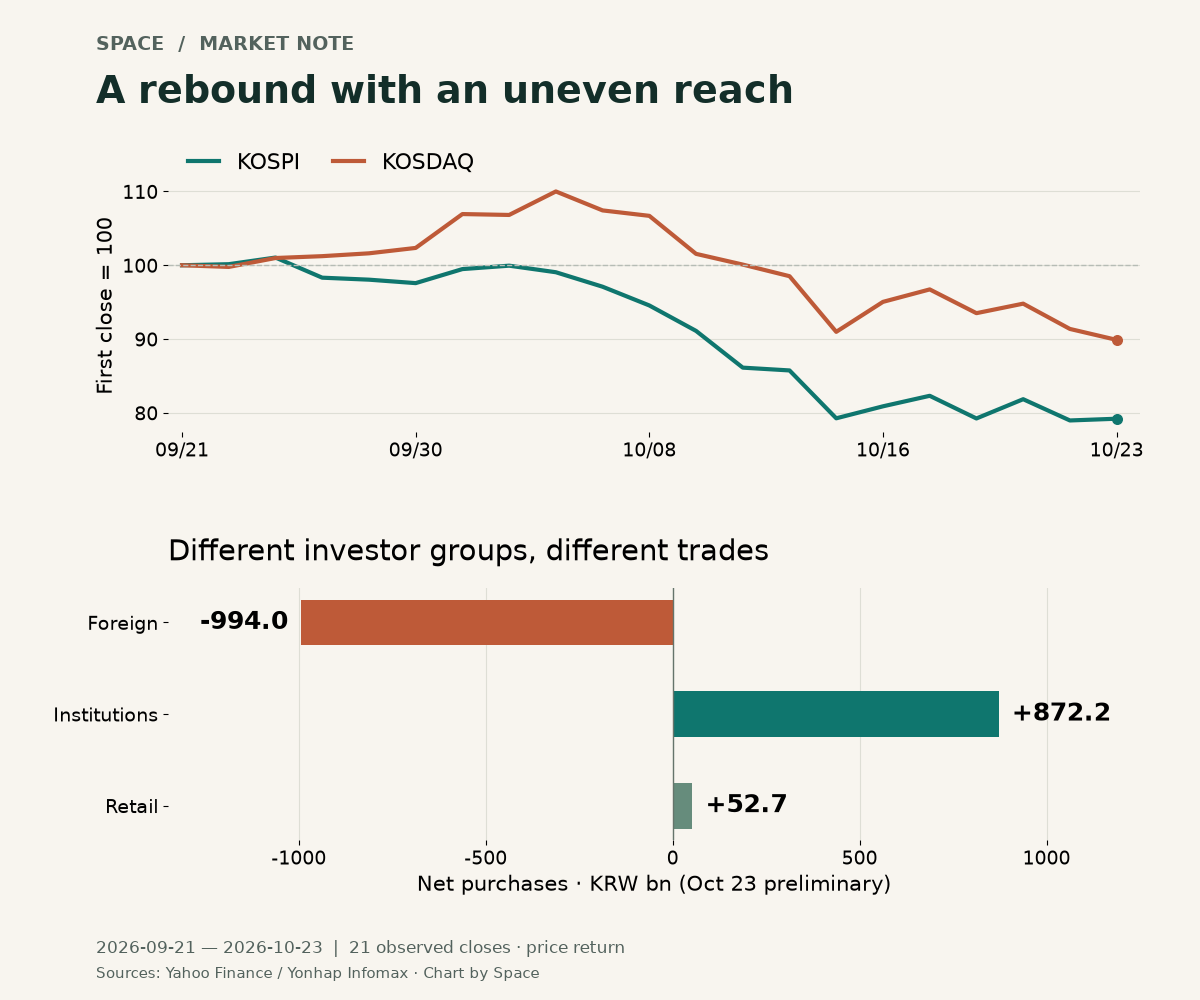
The top panel sets September 21 to 100 and connects 21 observed closes across 20 trading-session intervals. The KOSPI declined 20.80% and the KOSDAQ 10.11% over that window. Over the shorter five-session period, however, the KOSDAQ performed worse. Friday's relative strength does not erase the KOSPI's earlier decline. Claims that one market is “stronger” need a stated comparison period.
The lower panel shows preliminary KOSPI net purchases by investor group, in billions of won. Foreign investors' -994.0 therefore means KRW 994.0 billion of net selling. Other investor categories are omitted, so the three bars do not sum to zero.
1. A semiconductor rebound had a narrower reach than the headline index
SK hynix's decision to stop reviewing an initial public offering of Solidigm was reported as an important catalyst for the recovery. The event eased uncertainty about how value might be divided between a parent company and a separately listed subsidiary. It does not establish that the company's long-term profitability changed in a single trading day. Report on the announcement
A subsidiary listing places shares in part of a parent's business on the market separately. It can raise useful capital, but it can also complicate the calculation of how existing parent-company shareholders participate in future growth. Listing is not automatically harmful, and abandoning a listing is not automatically beneficial. The purpose of the financing, ownership structure and shareholders' rights all matter.
The KOSPI gives greater weight to companies with larger market values. A recovery in major semiconductor shares can therefore lift the index while many other holdings remain weak. The falling KOSDAQ is one reason to hesitate before calling Friday a complete recovery in confidence. The next useful question is whether gains spread to other companies and industries.
ETF investors face the same issue. A long holdings list does not guarantee low exposure to one sector. A KOSPI tracker, a KOSDAQ product and a semiconductor fund may all be described as Korean equity investments, yet behave differently. Reading the largest holdings and their weights is more informative than relying on a fund's name alone.
2. Foreign investors sold shares while institutions bought
Yonhap Infomax's 3:53 p.m. closing report recorded KOSPI institutional net purchases of KRW 872.2 billion, foreign net selling of KRW 994.0 billion, and retail net purchases of KRW 52.7 billion. Both language editions use this same preliminary snapshot rather than mixing later estimates or totals from separate trading venues. Investor-flow report
The foreign-investor classification includes many strategies and investment horizons. Its net selling does not by itself prove that major global investors have abandoned Korea. Cash equities, derivatives and currency hedges answer different portfolio needs. The aggregate cannot reveal a named investor's private intention.
In government-bond futures, foreign investors reportedly bought a net approximately 1,000 three-year contracts and 3,600 ten-year contracts on the same day. Contract counts are not cash inflows and cannot simply be added to, or subtracted from, stock-sale amounts. Futures can express a directional view or offset risks elsewhere. Bond-futures flows
Those observations support a limited but useful conclusion: the same broad investor category behaved differently across asset classes. They do not trace the same money from a specific stock sale into a specific bond purchase. That stronger claim would require investor-level evidence that these reports do not provide.
3. A nearly unchanged exchange rate concealed two-way pressure
USD/KRW closed at 1,324.60 at 3:30 p.m. in Seoul, up 0.40 won, after trading between 1,321.50 and 1,326.80. The closing report described exporter dollar sales and buying interest near the lower end of the range. Dealers' suggestions of official or pension-related buying remain unconfirmed attribution, not established intervention. Currency report
An exporter converting overseas receipts into won supplies dollars to the market. Importers paying dollar invoices and investors buying overseas assets can create demand in the other direction. Foreign stock sales alone cannot explain the exchange rate. The connection depends on whether the seller converts the proceeds, buys another won asset or already has a currency hedge.
For the broader backdrop, the Bank of Korea's October 22 explanation linked recent won strength to a large current-account surplus and improved foreign-exchange supply and demand. A currency can strengthen against the dollar even during a broader period of dollar strength. Friday's small rebound in USD/KRW is insufficient on its own to establish a reversal of that trend. Bank of Korea explanation
For a Korean investor holding an unhedged overseas ETF, a stronger won reduces the won value of an unchanged dollar asset. For someone who still needs to buy dollars, it reduces the won cost of that purchase. Whether an exchange-rate move helps depends on the currency of the person's assets, liabilities and future spending.
4. Why bond yields fell while the policy rate stayed unchanged
The Bank of Korea held its base rate at 3.00% on October 22, with all seven board members in agreement. Its explanation retained concerns about inflation and financial imbalances while allowing time to assess two earlier increases. Further increases remained conditional on incoming evidence. A pause should not be translated into a promise to cut. Policy decision
On Friday, the three-year government yield fell 3.7 basis points to 3.803% and the ten-year fell 5.5 basis points to 4.097%. The gap between them narrowed from 31.2 to 29.4 basis points. The curve became slightly flatter because the longer yield fell further. The closing report described support from the previous US bond rally, followed by a partial reversal as equities and US yields recovered during Asian trading. Bond-market report
The central bank sets the policy rate. Market participants trade government bonds based on expected inflation, future policy, supply and demand. The two rates need not move together every day. Existing fixed-rate bond prices generally rise when yields fall: holders may gain on valuation while new buyers receive a lower prospective yield.
Maturity matters for bond ETFs. Longer-duration bonds are generally more sensitive to interest-rate changes. That can produce larger gains when yields fall, but also larger losses when yields rise. Understanding maturity and credit exposure is more useful than assuming every bond product provides the same protection.
Three questions for the next session
| Question | Evidence to watch |
|---|---|
| Does the semiconductor rebound broaden? | Recovery in the KOSDAQ and other industries, rather than support from only a few large names |
| Do the investor flows persist? | Cash equities, bond futures and currencies compared separately using consistent dates and units |
| Does global rate uncertainty ease? | Policy communication and market-yield reactions around the October 27–28 FOMC meeting |
The official FOMC dates are US local dates. The meeting's outcome has not yet been announced.
The KOSPI's recovery mattered. The KOSDAQ, foreign equity sales and longer-period returns nevertheless told different stories. Welcoming a positive close while checking how widely the improvement is shared is a useful habit: it leaves room for relief without turning one session into proof that the entire correction has ended.
This is an educational market record, not a recommendation to buy or sell a security. Investor-flow figures are preliminary observations from the cited reports and may be revised.
Sources
- https://kbthink.com/news-list/view.html?newsId=20261023155352914
- https://query1.finance.yahoo.com/v8/finance/chart/%5EKS11?range=3mo&interval=1d
- https://query1.finance.yahoo.com/v8/finance/chart/%5EKQ11?range=3mo&interval=1d
- https://kbthink.com/news-list/view.html?newsId=20261023161402771
- https://kbthink.com/news-list/view.html?newsId=20261023165335984
- https://www.bok.or.kr/eng/bbs/E0000627/view.do?menuNo=400022&nttId=11065824
- https://www.federalreserve.gov/monetarypolicy/fomccalendars.htm