The morning brought news of stronger production and spending. By the afternoon, Korean share prices were falling sharply. Those two pictures could coexist on October 30. Economic statistics describe activity that has already taken place. Share prices ask what investors should pay today for earnings that have yet to arrive.
The KOSPI closed at 5,730.74 and the KOSDAQ at 724.38. Chip stocks fell, while the won strengthened and Korean government bond prices rose. Understanding the session therefore requires another question after “foreign investors sold”: which assets did they sell, and what did they buy elsewhere?
Session: October 30, 2026, KRX regular trading. Research cutoff: 2026-10-30 21:44 KST. Equity, foreign-exchange and bond observations have separate conventions below.
1. A sharp daily fall inside a longer adjustment
| Indicator | October 30 | Daily change | Five sessions | Twenty sessions |
|---|---|---|---|---|
| KOSPI | 5,730.74 | −3.48% | +3.25% | −16.19% |
| KOSDAQ | 724.38 | −3.83% | −3.63% | −15.37% |
| USD/KRW | 1,334.30 won | −2.50 won | +9.70 won | −18.50 won |
| Korean government bond, 3-year | 3.715% | −5.1bp | — | — |
| Korean government bond, 10-year | 4.008% | −7.3bp | — | — |
Equities are regular-session closes. USD/KRW is the 15:30 KST Seoul daytime close. Bond yields are the Korea Financial Investment Association's final quoted yields reported in the closing coverage. One basis point is 0.01 percentage point. Five- and twenty-session comparisons start on October 23 and September 30 respectively; a dash means no comparison was calculated. KRX close · FX close · Bond close
A large red number can make the preceding week seem uniformly bad. Yet the KOSPI remained 3.25% above last Friday's 5,550.30. The KOSDAQ fell over the same interval. The recent recovery had not reached both markets equally. Against September 30, both indexes were more than 15% lower: a short rebound was taking place within a much larger adjustment. KOSPI history · KOSDAQ history
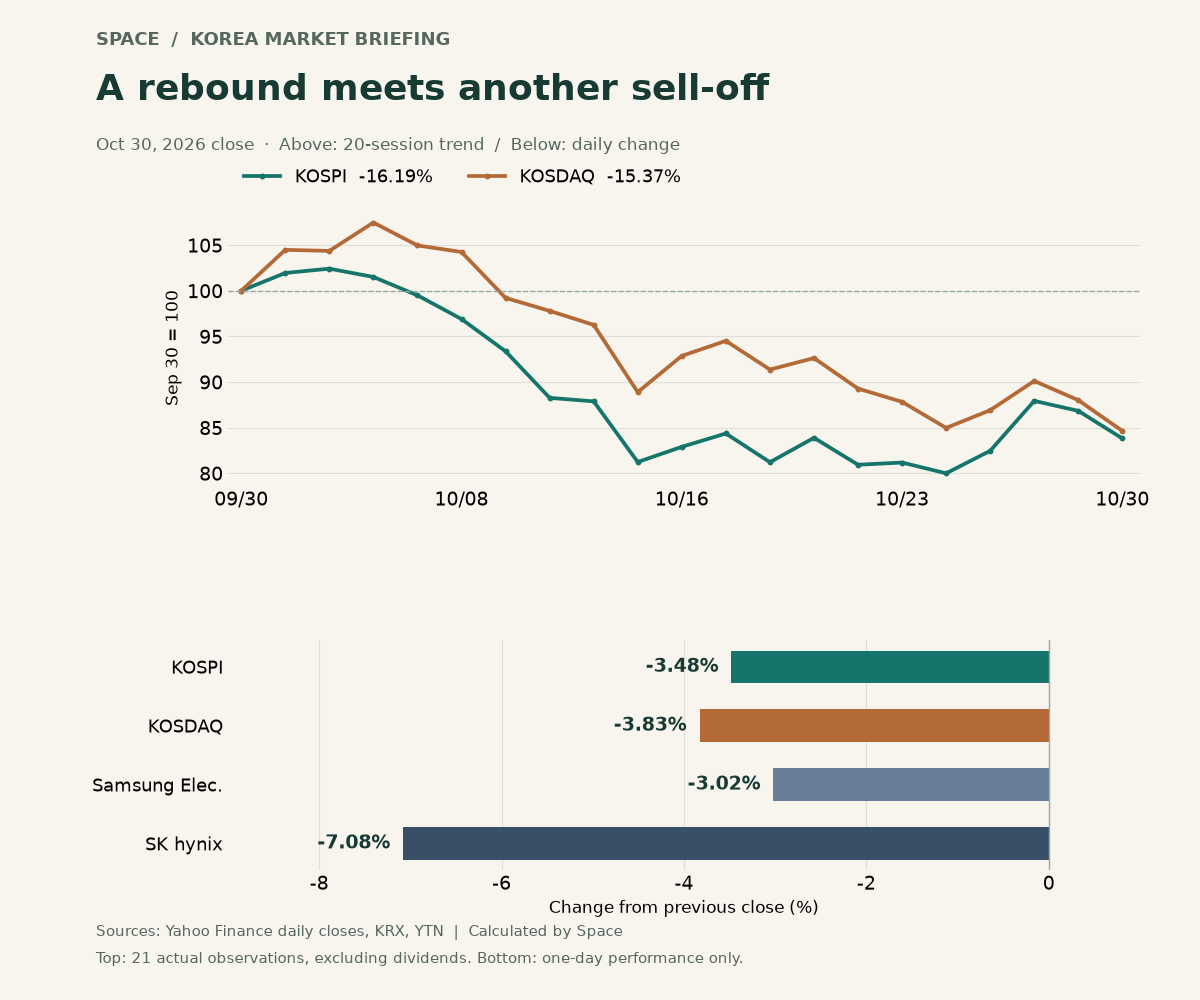
The upper panel rebases 21 actual closing observations, September 30 through October 30, to 100. Trading sessions are equally spaced; holidays are omitted and dividends excluded. The lower panel compares this session alone.
Samsung Electronics fell 3.02% to 225,000 won; SK hynix dropped 7.08% to 1,418,000 won. KRX identified U.S. company earnings and concerns about returns on AI investment as background to the selling. Samsung prices · SK hynix prices · Closing coverage
The overseas connection came from the October 29 U.S. regular session. The Nasdaq-100 lost 1.38% to 29,402.51, while the S&P 500 declined 0.30% to 7,720.39. The Nasdaq-100 is distinct from the Nasdaq Composite; this briefing uses the former to track large technology-oriented companies. These observations precede the Korean session, rather than describing a completed October 30 U.S. session. Nasdaq-100 · S&P 500
AI spending creates an expectation of orders for chip suppliers. But investors also need confidence that the customers financing that spending can earn an adequate return. Doubts about the second proposition can reduce the price investors pay for future orders, even when current earnings remain strong. Today's evidence supports concern about that relationship; it does not establish that Korean manufacturers suddenly lost orders today.
2. Foreign investors sold shares and bought index futures
The following KRX figures are a 15:45 KST snapshot, in units of 100 million won. Positive values mean net buying. Futures figures are trading-value amounts, not contract counts, and should not simply be added to the cash-equity amounts. KRX investor breakdown
| Market | Foreign investors | Institutions | Individuals |
|---|---|---|---|
| KOSPI cash equities | −16,195 | +7,445 | +6,211 |
| KOSPI 200 futures | +13,580 | −13,136 | −262 |
| KOSDAQ cash equities | −276 | −1,380 | +1,692 |
Electrical and electronic shares accounted for 1.0995 trillion won of foreign net selling on the KOSPI. Pressure was concentrated in the industry that includes the major chipmakers. But foreign futures trading went in the other direction. The aggregate figures cannot reveal whether the same investors placed both sets of trades, closed existing positions or pursued a price-difference strategy. They do not prove that overseas investors collectively decided to leave Korea.
There was more direct evidence of strained trading conditions. KRX activated a sell-side sidecar at 10:04 KST, following the specified sharp fall in KOSPI 200 futures. The measure suspended the effectiveness of program sell orders for five minutes. It was not a closure of the entire stock market. Official KRX notice
KRX also reported declines of 3.7%, 1.1% and 1.5% in large-, mid- and small-cap shares. The largest companies fell most, but weakness extended beyond them. That distribution, together with the sidecar, supports an interpretation of substantial pressure to reduce risk. Institutional and individual buying on the KOSPI nevertheless shows that investors were responding differently. A stressed market does not imply a single shared intention.
3. A stronger won and stronger government bonds
USD/KRW measures the won needed to buy one dollar. Its fall to 1,334.30 therefore represented a stronger won. However, the rate remained above 1,324.60 five sessions earlier and below 1,352.80 twenty sessions earlier. Daily won strength and weekly won weakness can both be true. October 23 daytime close · September 30 daytime close
Yonhap Infomax reported exporter dollar selling and foreign dollar-futures net selling as contributing factors. It also discussed currency-hedge adjustments as a possible explanation. That is an attributed market interpretation, not a demonstrated chain of transactions in individual accounts. Proceeds from share sales are not necessarily exchanged into dollars immediately; foreign equity selling does not mechanically require a weaker won. FX reporting
Nor does one bilateral exchange rate describe the dollar everywhere. KRX's 15:45 reference snapshot put the dollar index at 101.9, down 0.2%. Weakness against a basket of major currencies was also visible. This was not a final New York FX close. KRX reference prices
In bonds, the ten-year yield fell more than the three-year yield. Their gap narrowed from 31.5 to 29.3 basis points. Lower yields generally mean higher prices for existing fixed-rate bonds: paying more for the same stream of interest leaves the new purchaser with a lower return.
Closing coverage cited risk aversion and WGBI-related foreign demand for cash bonds. Yet foreigners were net sellers of approximately 800 three-year and 1,200 ten-year bond-futures contracts. Reported demand for cash securities and recorded futures trades are different evidence. Neither supplies a verified net-inflow amount for a named foreign fund. Bond-market close
For readers comparing stock ETFs with government-bond ETFs, today's divergence illustrates different exposures. Corporate earnings expectations matter to the former; changing yields matter to the latter. Government-bond ETFs still fluctuate in price. Providing a cushion in this session does not guarantee a positive return in the next one.
4. Better production data, but a different question for stocks
The September activity data released today showed all-industry production up 3.0% month over month, retail sales up 3.6% and equipment investment up 5.3%. The government described a rebound from August weakness associated with automaker strikes and summer holidays. All three monthly measures improved, but retail sales for the third quarter as a whole fell 1.0% from the preceding quarter. Ministry release via Korea Policy Briefing
Changing the comparison period changes the story. One strong month does not establish a broad consumer boom. Equally, a weak stock market does not erase a measured improvement in production. Statistics record completed activity; equities value the earnings investors expect that activity to generate next.
Our reading is that concern over AI investment returns was more visible in share prices today than the backward-looking improvement in activity. The next test is whether production gains persist and are accompanied by stronger orders and earnings expectations. We did not verify a matching pre-release consensus for these data, so the reported growth rates alone are not described as an upside surprise.
5. The BOJ held rates and changed its ETF sale plan
The Bank of Japan kept its short-term policy rate at 1.25%, with an 8–1 vote. It also decided to increase the annual pace of ETF sales from roughly 330 billion yen to 860 billion yen on a book-value basis, starting in January 2027. BOJ policy statement
This is a published asset-reduction plan, not evidence that the annual amount was sold today. A book-value pace is also different from actual proceeds at market prices. It should not be combined with Korean foreign-investor trading into a single supposed capital-flight event.
The BOJ's outlook treated AI demand as a support for growth while warning of asset-price adjustment pressure if profits failed to match investment. Expectations for chip demand and scrutiny of the returns sustaining it therefore belong in the same discussion. That does not establish the BOJ announcement as the principal cause of Korea's sell-off. BOJ economic and price outlook
Three questions carry into next week. If equities rebound, do the KOSDAQ and smaller companies participate? If USD/KRW and bond yields continue falling, how do foreign cash and futures positions evolve? And do AI-related order and earnings forecasts justify the scale of investment? The BOJ is scheduled to publish its full outlook report on November 2 at 14:00 JST/KST, providing further detail behind its assessment. Official release schedule
Today's numbers show how improving activity and falling stocks can coexist, and how one investor category can trade different assets in opposite directions. Before drawing an investment conclusion, align the market, period and units being compared. This briefing is educational material for understanding markets.
Sources
- https://open.krx.co.kr/contents/MKD/01/0101/01010000/MKD01010000.jsp#view=2026103041
- https://open.krx.co.kr/contents/OPN/05/05000000/OPN05000000.jsp#fe3647848b826aa1ddee224c4b5526f4=1&view=261015861
- https://m.ytn.co.kr/news_view.php?key=202610301636383859&s_mcd=0102
- https://news.einfomax.co.kr/news/articleView.html?idxno=4442264
- https://news.einfomax.co.kr/news/articleView.html?idxno=4442274
- https://m.korea.kr/news/policyNewsView.do?newsId=148974637&pWise=mSub&pWiseSub=RT6
- https://www.boj.or.jp/en/mopo/mpmdeci/mpr_2026/k261030a.pdf
- https://www.boj.or.jp/en/mopo/outlook/gor2610a.pdf
- https://query1.finance.yahoo.com/v8/finance/chart/%5EKS11?range=3mo&interval=1d
- https://query1.finance.yahoo.com/v8/finance/chart/%5EKQ11?range=3mo&interval=1d
- https://query1.finance.yahoo.com/v8/finance/chart/005930.KS?range=3mo&interval=1d
- https://query1.finance.yahoo.com/v8/finance/chart/000660.KS?range=3mo&interval=1d
- https://query1.finance.yahoo.com/v8/finance/chart/%5ENDX?range=3mo&interval=1d
- https://query1.finance.yahoo.com/v8/finance/chart/%5EGSPC?range=3mo&interval=1d
- https://www.ziksir.com/news/articleView.html?idxno=150603
- https://www.ytn.co.kr/_ln/0102_202609301546261151
- https://open.krx.co.kr/contents/MKD/01/0110/01100305/MKD01100305.jsp