Before investing, it is easy to say, “If prices fall, I will buy more.” When the balance actually declines, the decision feels different. It feels more different still if work has become uncertain or a large medical bill has just arrived.
Investment decisions do not happen inside a portfolio alone. Salary, family, debt, and next month’s commitments occupy the same person’s life.
This final lesson puts those circumstances onto one page. The purpose is to record a basis for decisions when the future turns out differently from what you imagined.
Write down the date before the return
Jiyun’s original goal was to make more money. She now adds a purpose and a date: money for a move in two years, a reserve against interrupted income, and money for life much further ahead.
Different purposes create different capacities for risk. A fixed moving date may not allow time to wait for a market recovery. Longer-term money is not infinitely patient either, but its spending date may be more flexible.
Only then does she consider how to divide investments among equities, bonds, and cash-like assets. Asset allocation describes decisions between broad asset categories. Time horizon and the ability and willingness to bear losses affect what is appropriate. Diversification can reduce concentration without eliminating market losses. Investor.gov asset allocation guide
Someone else’s allocation cannot be separated from their income, obligations, and dates. This course does not offer one percentage mix as the answer for every reader.
Willingness and financial capacity are different
You may feel comfortable with uncertainty while lacking the cash to wait through a decline. You may also have sufficient resources while finding volatility harmful to sleep and everyday life.
Write down the possibility of an investment falling from 10 million won to 7 million. “Could I remain invested after losing 3 million won?” is more concrete than “Can I tolerate volatility?”
Place the date when money is needed beside that question. Include other assets, debt payments, and possible changes in income.
Recovery arithmetic also matters. A fall from 100 to 80 is a 20% loss. Returning from 80 to 100 requires a 25% gain because the starting amount is smaller.
| Loss from original amount | Amount remaining, starting at 100 | Gain needed to recover |
|---|---|---|
| −10% | 90 | About +11.1% |
| −20% | 80 | +25% |
| −30% | 70 | About +42.9% |
| −50% | 50 | +100% |
No contributions, withdrawals, or costs. The calculation predicts neither recovery nor its timing.
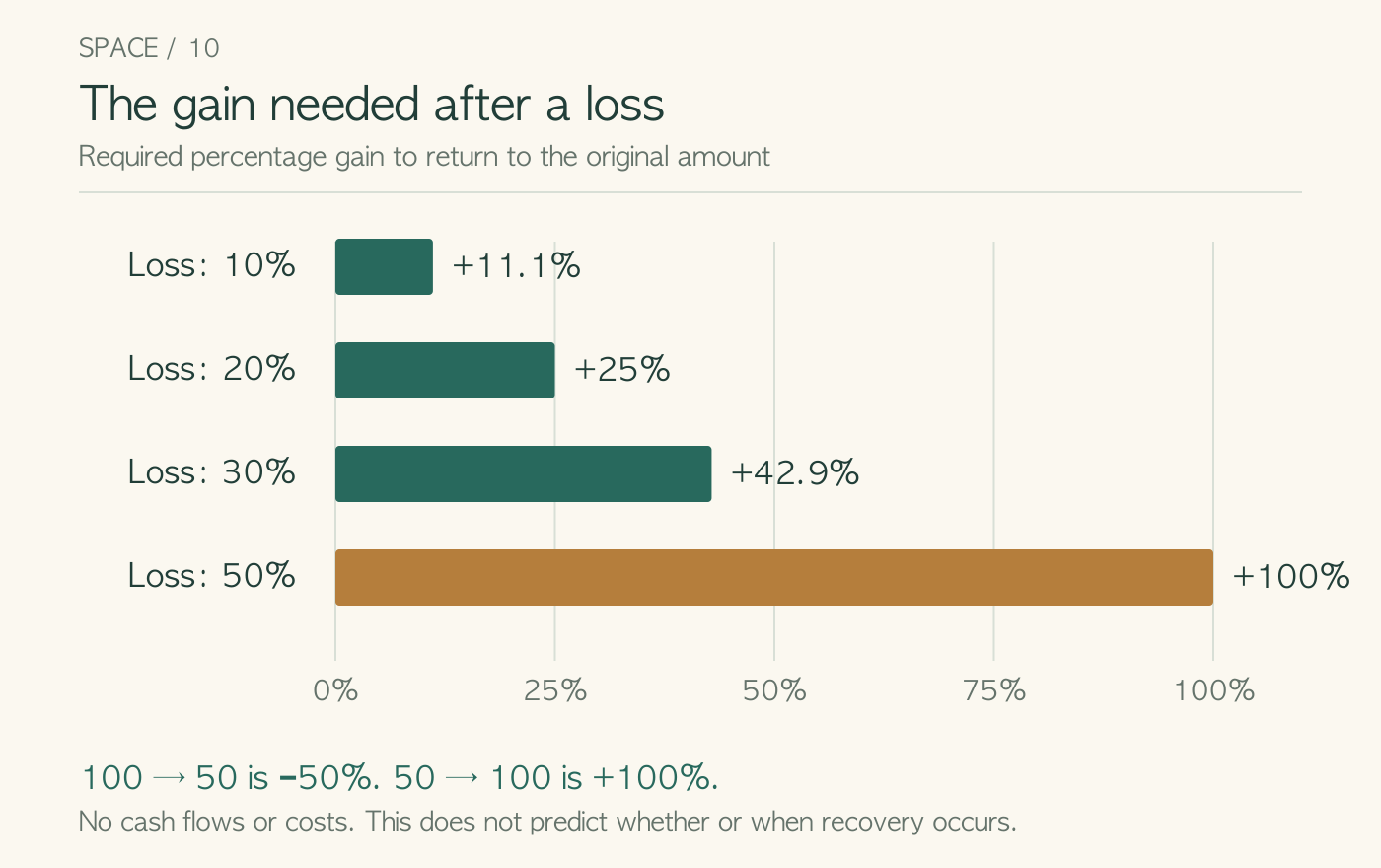
Figure: an original illustration based on the assumptions and calculations in the text.
Avoiding every form of market risk leaves other issues, including inflation and opportunity cost. Pursuing return without limits can create losses you cannot sustain. The task is to identify the kinds and amounts of risk your plan can accommodate.
What regular investing changes
Investing a fixed sum at regular intervals buys more units when prices are low and fewer when prices are high. This is commonly called dollar-cost averaging. Investor.gov explanation
A lower average purchase price does not guarantee a profit. Consider an invented sequence with an investment of 120,000 won each time. Whole units can be purchased at these prices, and costs are excluded.
| Purchase | Unit price | Amount invested | Units bought |
|---|---|---|---|
| First | KRW 10,000 | KRW 120,000 | 12 |
| Second | KRW 8,000 | KRW 120,000 | 15 |
| Third | KRW 6,000 | KRW 120,000 | 20 |
| Total | KRW 360,000 | 47 |
The average purchase price is about 7,660 won, below the first purchase price. Yet 47 units valued at the final price of 6,000 are worth only 282,000 won. The loss is 78,000 won, or about 21.7%.
Regular purchases changed the entry prices. They did not remove the asset’s decline.
Also distinguish investing newly earned monthly savings from deliberately delaying investment of a lump sum already available. Staging a lump sum can reduce the emotional burden of one entry date. It can also create opportunity cost if markets rise while part of the money waits in cash.
Comfort with a method and superiority of its future returns are separate questions.
Returning to the intended mix
Imagine 10 million won of long-term investment money divided into 6 million in equities and 4 million in other assets. The 60–40 mix is an arithmetic example, not a recommendation.
Equities rise 20% to 7.2 million while the other assets remain at 4 million. The portfolio now totals 11.2 million, and equities account for about 64.3%.
Restoring the original 60% equity weight would mean holding 6.72 million in equities. Moving 480,000 won from equities to the other assets restores the mix before taxes and costs. Alternatively, future contributions can be directed toward underweight holdings.
This adjustment is rebalancing. Its purpose is to manage the intended risk mix, rather than predict the next winning asset.
A preselected review schedule or tolerance band can reduce the temptation to reconstruct the portfolio after every headline. But trading has costs and tax implications. Correcting every tiny movement is not automatically beneficial.
Your intended allocation can also change legitimately. A goal approaching, unstable income, or new family responsibilities may justify reconsidering the plan itself. Consistency does not require ignoring changes in your life.
Write down what would change your mind
Many people record a reason to buy without recording a reason to reconsider.
For an individual company, you might monitor whether the business assumptions still hold and whether debt and cash flow remain manageable. For a fund, you might examine changes in objective, structure, or cost.
Your purchase price is a historical fact. It does not by itself establish whether continued ownership makes sense now. Equally, a rising price does not prove every part of the original analysis was correct.
Use the following page as a draft. An unanswered question is an acceptable entry.
| Part of the plan | What to record |
|---|---|
| Purpose and date | What the money is for and when it is needed |
| Money kept outside investing | Living costs, reserves, and near-term commitments |
| Contributions | An affordable amount and schedule |
| Risk limits | Possible monetary loss, cash needs, effect on daily life |
| Holdings | Whether you can explain structure and costs |
| Review and adjustment | Review frequency and allocation rules |
| Reasons to reconsider | Changes in circumstances or investment assumptions |
You need not rewrite the page constantly. When you do change it, record the date and reason.
Remembering only outcomes can turn good luck into apparent skill, or make a reasonable decision with a poor outcome look foolish. Recording what you knew and did not know helps you evaluate the process more fairly.
Ten lessons will not let you identify the next crisis in advance. They can help you distinguish an account balance from available money, profit from cash, and a quoted return from a result measured over time and after costs.
On an unsettled market day, open this page before looking for another forecast. The dates and needs you recorded may be easier to rely on than the mood of the moment.