Korean trading session: October 28, 2026. Research cutoff: October 28, 2026, 21:47 KST. Equities use regular-session closes; USD/KRW uses the Seoul 3:30 p.m. daytime close; government bonds use 4:30 p.m. closing indicative yields. All Korean times are KST.
The KOSPI gained 374 points in a single day, putting 6,000 back on the screen. Samsung Electronics and SK hynix led the advance. Yet the won weakened and bond prices fell. Looking only at stocks would capture the relief, while missing the reservations elsewhere.
Two developments were happening together: investors were reassessing semiconductor earnings, and markets were still managing interest-rate and currency risk. Understanding that combination is more useful than treating every rising stock as evidence that uncertainty has disappeared. Today's move, the path over the past month and the next policy announcement answer different questions.
Back above 6,000, but still below the starting point
| Measure | October 28 level | One-day change | Five sessions | Twenty sessions |
|---|---|---|---|---|
| KOSPI | 6,012.44 | +374.10 points / +6.63% | +4.83% | −12.73% |
| KOSDAQ | 771.28 | +27.45 points / +3.69% | −2.71% | −8.89% |
| USD/KRW | KRW 1,337.70 per USD | +KRW 14.00 | +KRW 12.50 | Comparable series not verified |
| Korean government bond, 3-year | 3.799% | +4.1 basis points | — | — |
| Korean government bond, 10-year | 4.108% | +7.6 basis points | — | — |
Five-session comparisons start at the October 21 close; twenty-session comparisons start at September 28. Space calculated index changes from daily closing prices, excluding dividends. The currency comparison uses October 21's comparable daytime close of KRW 1,325.20. One basis point is 0.01 percentage point. Sources: KRX's daily brief, October 21 currency close and closing bond yields.
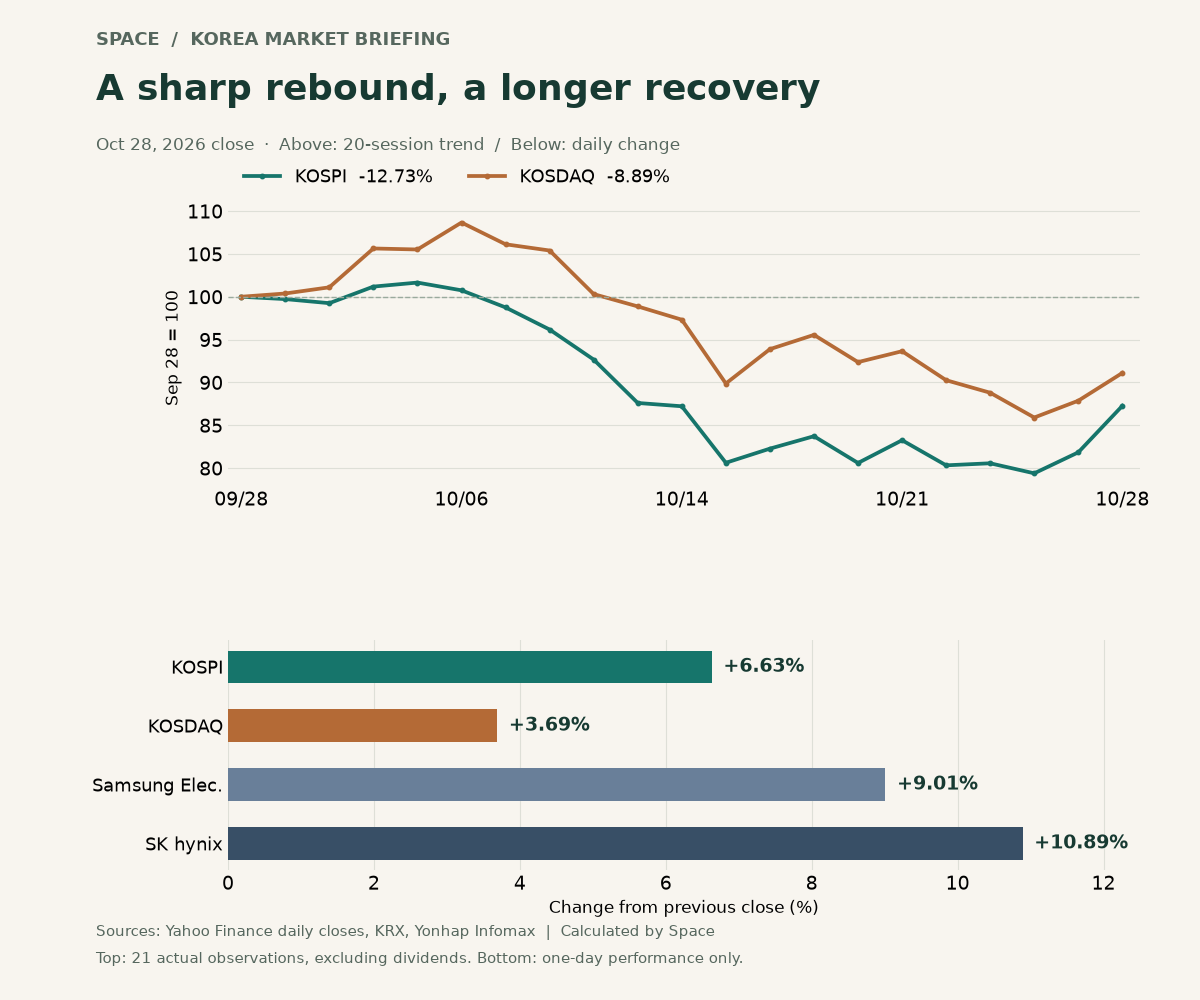
The top chart sets each index's September 28 close to 100 and connects 21 actual observations, omitting non-trading days. The lower chart compares today's gains only. Together they distinguish the size of a rebound from the distance still left to recover.
The KOSPI is above its level five sessions ago, while the KOSDAQ is still below it. Both remain below their twenty-session starting points. Today's strength matters, but it does not by itself establish a lasting upward trend. A different starting date changes the question a return figure answers. The chart uses KOSPI daily data and KOSDAQ daily data; the starting levels also match September 28 closing coverage.
There was an equally important difference within the market. KRX reported gains of 7.1% for KOSPI large caps, 1.8% for mid caps and 0.7% for small caps. Larger companies made much stronger advances. Their heavier influence helps explain why an index can feel very different from an individual portfolio. An index ETF can own many stocks and still be sensitive to a heavily weighted industry. Counting holdings alone does not tell us how widely its risks are spread.
Earnings, dividends and the distinction between a plan and cash paid
SK hynix rose 10.89% and Samsung Electronics 9.01%. SK hynix reported preliminary third-quarter revenue of KRW 104.6155 trillion and operating profit of KRW 83.3338 trillion, citing AI memory and higher-value server demand. Its quarterly dividend is KRW 20,000 per share: KRW 10,000 linked to earnings and KRW 10,000 as a special dividend from Kioxia investment gains. Company results; share-price reaction.
Of the KRW 20 trillion buyback approved today, KRW 10 trillion is intended for cancellation and KRW 10 trillion for employee compensation. Counting the whole purchase as shareholder returns would overstate it. Preliminary accounts can change, and announced purchases are distinct from completed repurchases and cancellations.
For a beginner, the word “special” deserves attention. Distributing a gain from an investment is different from generating recurring operating cash. Multiplying one quarter's dividend by four does not establish the income an investor will receive next year. Nor is a dividend money created outside the company: cash moves from the business to its owners. The resources left for future investment remain part of the valuation question.
The favorable price reaction is consistent with the announcement improving investors' assessment of the business. It does not establish that the announcement explains every part of the rally. KRX also pointed to the previous US session's strength and improving AI-related sentiment. The next test is whether earnings persist and whether cash generation keeps pace with investment requirements. A rising share price does not supply those future answers.
Following investors without inventing their intentions
Flows become useful when the investor group, asset and observation time are specified. This table uses KRX's 3:45 p.m. compilation, without mixing later revisions or different trading scopes.
| Cash equity market | Foreign investors | Institutions | Individuals |
|---|---|---|---|
| KOSPI | +KRW 823.3 billion | +KRW 960.2 billion | −KRW 1,801.7 billion |
| KOSDAQ | −KRW 183.5 billion | +KRW 224.8 billion | −KRW 31.6 billion |
Figures are net purchases; negative values mean net sales. Only three selected investor groups are shown, so rows need not sum to zero. Source: KRX daily brief.
Foreign and institutional investors bought KOSPI shares together. In KOSDAQ shares, institutional buying coincided with foreign selling. That is more specific than saying overseas investors bought everything Korean.
Outside equities, foreign investors sold a net 1,867 three-year government-bond futures contracts and 4,543 ten-year contracts. The directions of equity and bond-futures transactions differed. These aggregates do not prove that the same investors sold bonds to buy stocks. Futures may also be used to offset existing risks. Bond-market closing report.
The size of the large-cap advance and the split in investor flows are two separate clues to sentiment. Together they suggest renewed willingness to take risk concentrated in large semiconductor shares, rather than an end to caution across all assets. Higher turnover would not, by itself, establish an equal amount of new net money entering the market. Every share traded has both a buyer and a seller.
Why stronger stocks can coexist with a weaker won and bonds
USD/KRW measures how many won buy one dollar. Its rise to 1,337.70 means the won weakened. It is KRW 12.50 above the daytime close five sessions earlier; today's increase alone was KRW 14.00. Currency trading continues after the daytime close, so this is not a final overnight price.
Yonhap Infomax attributed the move partly to covering dollar-short positions and possible currency hedging. It also described concern about future dividend remittances. That is not evidence that those dividends were sent overseas today. Owning Korean shares and protecting against a weaker won can coexist. Reported market explanations should not be mistaken for verified intentions of every participant. Foreign-exchange closing analysis.
Broad dollar conditions deserve a separate check. KRX's 3:45 p.m. reference snapshot showed the dollar index around 102.3, up approximately 0.3% against its comparison base. This is distinct from USD/KRW and is not the October 28 US closing value. It provides a cross-check instead of inferring worldwide dollar strength from one exchange rate.
In bonds, the ten-year yield rose more than the three-year yield. Their gap widened from 27.4 to 30.9 basis points. Prices of existing fixed-rate bonds generally fall when market yields rise: if newly available bonds offer more interest, an older lower-coupon bond needs a lower price to compete. ETFs holding longer-maturity bonds can be more sensitive to such changes.
The economic backdrop also matters. The Bank of Korea's preliminary third-quarter GDP release, published October 27, showed growth of 1.0% from the previous quarter and 3.4% from a year earlier. This was yesterday's release, not fresh news today. GDP measures production across the economy; it is not interchangeable with one company's profits or every household's experience. BOK GDP release.
On October 22, the BOK held its policy rate at 3.00% while keeping the timing and pace of further increases dependent on growth, inflation and financial stability. An unchanged rate did not signal a turn toward easing. Stocks could respond favorably to earnings while bonds continued to price future borrowing costs. Those reactions can coexist. BOK monetary-policy decision.
The next major checkpoint is the FOMC decision at 3:00 a.m. KST on October 29, followed by the 3:30 a.m. press conference. These correspond to 2:00 p.m. and 2:30 p.m. US Eastern time on October 28. Neither had occurred by this briefing's research cutoff. Federal Reserve official calendar.
Three questions will help interpret the next session: Does pressure from the dollar and yields ease after the Fed? Does the advance broaden beyond large semiconductor companies? Do foreign and institutional purchases of KOSPI shares persist? Better earnings can be offset if financing and valuation pressures rise faster. Conversely, calmer rates and wider participation would add evidence that the rebound has a firmer foundation. Today's large gain is a result to examine, not a promise about tomorrow.
This briefing is educational. Each figure uses its stated observation time; it is not a recommendation to buy or sell a particular asset.
Sources
- https://open.krx.co.kr/contents/MKD/01/0110/01100305/MKD01100305.jsp
- https://open.krx.co.kr/contents/MKD/01/0101/01010000/MKD01010000.jsp#view=2026102811
- https://query1.finance.yahoo.com/v8/finance/chart/%5EKS11?range=3mo&interval=1d
- https://query1.finance.yahoo.com/v8/finance/chart/%5EKQ11?range=3mo&interval=1d
- https://go.seoul.co.kr/news/newsView.php?id=20261021500227
- https://www.etnews.com/20260928000355
- https://news.skhynix.com/en/q3-2026-business-results/
- https://news.einfomax.co.kr/news/articleView.html?idxno=4441701
- https://news.einfomax.co.kr/news/articleView.html?idxno=4441703
- https://www.bok.or.kr/portal/bbs/B0000501/view.do?depth=201264&menuNo=201264&nttId=11065944&programType=newsData&relate=Y
- https://www.bok.or.kr/portal/bbs/P0000559/view.do?depth=200690&menuNo=200690&nttId=11065823&programType=newsData&relate=Y
- https://www.federalreserve.gov/newsevents/2026-october.htm