At half past three on Tuesday afternoon, a dollar cost 2.80 won less in Seoul than it had on Monday. On the same afternoon, the KOSPI lost more than 210 points. Foreign investors sold over a trillion won more in Korean main-board shares than they bought. If the sellers had immediately exchanged all their proceeds for dollars, you might have expected a dollar to get more expensive. One of the orders that caught currency dealers’ attention, though, ran the other way. Someone needed won for an investment in a Korean company. Korea Exchange session report · Seoul currency market close
One session, three starting points
| November 3 | Close | One session | Five sessions | Twenty sessions |
|---|---|---|---|---|
| KOSPI | 5,648.79 | −3.59% | +0.19% | −19.35% |
| KOSDAQ | 704.39 | −4.08% | −5.30% | −21.15% |
| Won per US dollar | ₩1,341.00 | −₩2.80 | +₩17.30 | −₩9.60 |
The equity figures are Korea Exchange regular-session closes. The currency figures use the 3:30 p.m. Seoul daytime close throughout. Changes in the last row are amounts in won per dollar. The comparison dates are November 2, October 27 and October 2. Despite Tuesday’s dip, a dollar still bought 17.30 more won than it did the previous Tuesday. KOSPI history · KOSDAQ history · October 27 FX close · October 2 FX close
Monday’s rally had put 128.34 points on the KOSPI. Tuesday took away 210.29, leaving the index 81.95 points below Friday’s close. Go back just a little further and the picture changes again. At 5,648.79, the index finished a mere 10.45 points above its October 27 close of 5,638.34. An investor looking only once a week might have missed much of the drama. The same investor following the KOSDAQ would have seen a substantial loss, from 743.83 to 704.39. Closing market report · KOSPI · KOSDAQ
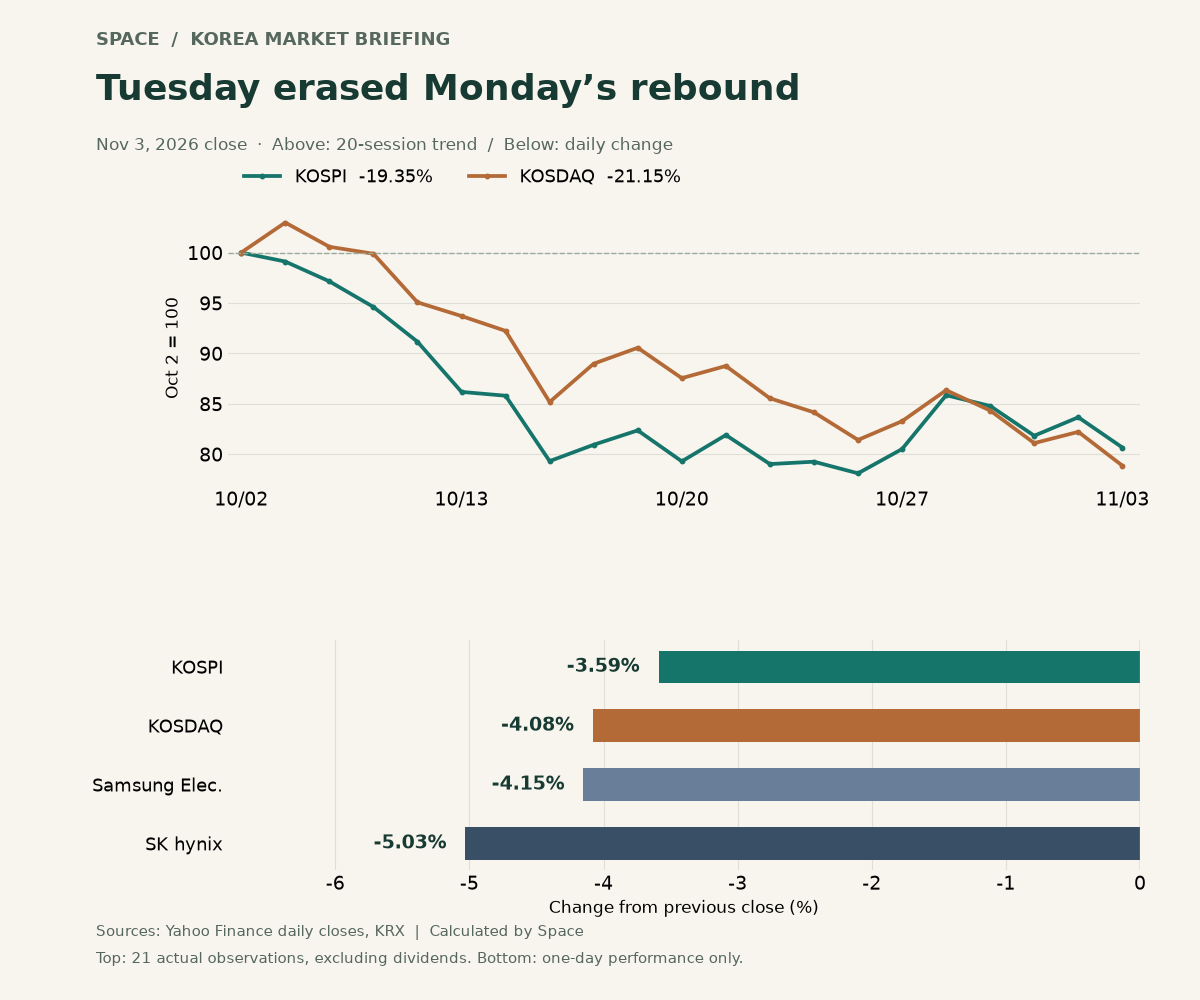
Each line in the top panel starts at 100 on October 2 and follows 21 actual closing observations, excluding dividends. The KOSPI ended near 81 and the KOSDAQ near 79. A nearly flat week on the KOSPI was quite possible within a month of steep losses. The lower panel narrows the lens to Tuesday. Samsung Electronics closed at ₩219,500, down 4.15%. SK hynix fell 5.03% to ₩1,398,000. Both chipmakers lost more than the main index. Samsung Electronics closes · SK hynix closes
Where the selling landed
| KRX cash shares, net purchases in ₩100 million | Foreign investors | Institutions | Individuals |
|---|---|---|---|
| KOSPI market | −15,295 | −5,108 | +16,602 |
| KOSDAQ market | −762 | −2,345 | +3,197 |
The exchange compiled these figures as of 3:45 p.m. A negative number means the group sold more shares by value than it bought. Foreign investors’ net sales on the main board came to ₩1.5295 trillion. Electrical and electronics stocks alone accounted for ₩1.1542 trillion of that, roughly three quarters. The sector fell 4.8%. Individuals bought more than they sold on both markets. The table covers three investor groups, so the columns need not add to zero. Exchange breakdown by sector and investor
KRX pointed to weakness in US technology shares the previous day and concerns about how soon spending on artificial intelligence would earn a return. Taiwan’s equity benchmark was also down 3.6% in the exchange’s regional snapshot. That gives the chip sell-off some international context. The size of Korea’s two chipmakers explains only part of the day, however. Large caps on the KOSPI fell 3.8%, mid caps 1.5% and small caps 1.4%. Machinery and equipment stocks on the KOSDAQ lost 6.7%. The size groups tell us how widely the weakness spread. The sector and flow figures tell us where the pressure was heaviest. KRX market breakdown · NewsPim closing report
The dollars behind a Korean share issue
The dollar opened at ₩1,346.00 and briefly reached ₩1,346.80 before selling turned it lower. Yonhap Infomax reported that dollars connected with Nvidia’s investment in Naver came to market ahead of the payment date. Foreign investors also sold a net roughly 66,400 dollar futures contracts. The dollar index, a measure against a basket of currencies, was lower at 101.761 in the Seoul report. The local need for won sat alongside weakness in the broader dollar and selling in currency futures. Each is a different piece of evidence about the day’s price. Seoul currency trading and dealer accounts
Naver’s amended filing after the stock-market close provides a particularly clear example of why the choice of exchange rate matters. Nvidia had agreed to subscribe for US$1 billion of shares. The issue price was fixed in Korean currency at ₩204,500 per share. An estimate in July had used ₩1,480.90 to the dollar. Under the agreement, the market-average rate observed around 4 p.m. Seoul time on November 3 was ₩1,341.20. A billion dollars now translated into fewer won, and therefore bought fewer shares at the same issue price. The final count was 6,558,435 shares, for proceeds of about ₩1.3412 trillion. The ₩1,341.00 daytime close and the ₩1,341.20 contractual rate were measured differently and served different purposes. Naver’s amended share-issue filing
Payment is due November 6. The filing establishes the terms of the issue. Dealers described dollar supply seen on November 3. Neither source quantifies how much of the billion dollars was converted on Tuesday. Nor do the separate stock and futures totals identify a single account behind the trades. It would be easy to turn the foreign equity sale into a matching dollar purchase on paper. Doing so would leave out the company transaction that people on the currency desk were actually watching. Subscription terms · FX reporting
Inflation met expectations. Long bonds drew buyers
Korea’s November 3 inflation release covered October. The consumer price index stood at 120.73, up 0.2% from September and 2.8% from a year earlier. Annual inflation had been 2.9% in September. Before the release, EDaily asked nine economists for forecasts. The medians were 0.2% month on month and 2.8% year on year. Both matched the figures published. It would take additional evidence to explain the day’s bond rally as a reaction to an unexpected inflation slowdown. Official CPI briefing · Pre-release survey
A family’s lunch bill offers another perspective on that slight easing. Restaurant prices were rising faster, at 2.9% year on year in October after 2.5% in September. Prices excluding food and energy rose 0.4% over the month, more than the headline index. A slower annual increase in a national basket leaves plenty of room for the price on a familiar menu to go up. Statistical agency’s discussion of the figures
Korea’s final quoted three-year government bond yield fell 0.4 basis points to 3.736%. The ten-year yield fell 3.3 basis points to 4.001%. One basis point is one hundredth of a percentage point. When a bond promises the same coupons and principal, paying more for it today lowers the yield its buyer can earn. Longer bonds saw the stronger rally, and the gap between the ten- and three-year yields narrowed from 29.4 to 26.5 basis points. Foreign investors sold a net 133 three-year government bond futures contracts and bought a net 8,146 ten-year contracts. A 30-year government bond auction attracted ₩3.936 trillion in bids for ₩2 trillion awarded. There is evidence of demand for longer maturities in the bond market’s own records, even though the figures cannot trace a won of equity-sale proceeds into a particular bond. Seoul bond close and auction results
Across the region, the Reserve Bank of Australia raised its policy rate from 4.60% to 4.85%, with six members voting to raise and three to hold. A policy rate set by a board in Australia and a price set by investors for ten years of Korean cash flows answer different questions. They moved in opposite directions on Tuesday. Reserve Bank of Australia decision · Korean government bond yields
In the next session, watch where orders land as well as where the KOSPI closes. A bounce concentrated in large chipmakers would look quite different from one that carried the KOSDAQ and smaller companies with it. In currencies, the November 6 payment date gives readers a reason to track demand for won separately from the broader dollar. Keeping those observations apart made Tuesday’s apparently contradictory closes easier to understand. KRX · Naver filing
Research cutoff 2026-11-03 23:12 KST. Equities use regular-session closes and FX uses the Seoul daytime close. This briefing is for financial education.
Sources
- https://open.krx.co.kr/contents/MKD/01/0101/01010000/MKD01010000.jsp#view=2026110331
- https://www.newspim.com/news/view/20261103001168
- https://query1.finance.yahoo.com/v8/finance/chart/%5EKS11?range=3mo&interval=1d
- https://query1.finance.yahoo.com/v8/finance/chart/%5EKQ11?range=3mo&interval=1d
- https://query1.finance.yahoo.com/v8/finance/chart/005930.KS?range=3mo&interval=1d
- https://query1.finance.yahoo.com/v8/finance/chart/000660.KS?range=3mo&interval=1d
- https://news.einfomax.co.kr/news/articleView.html?idxno=4442821
- https://biz.chosun.com/policy/policy_sub/2026/10/27/24VZMJ5MEFHC7C7XX3GH34EED4/?outputType=amp
- https://news.sbs.co.kr/amp/news.amp?news_id=N1008781009
- https://dart.fss.or.kr/dsaf001/main.do?rcpNo=20261103000311
- https://www.korea.kr/briefing/policyBriefingView.do?newsId=156787698
- https://www.edaily.co.kr/News/Read?mediaCodeNo=257&newsId=01374326645641784
- https://news.einfomax.co.kr/news/articleView.html?idxno=4442826
- https://www.rba.gov.au/media-releases/2026/mr-26-30.html