Anyone who opened the Korean market after reading about gains on Wall Street faced an uncomfortable surprise. On November 5, the KOSPI lost 300 points and the KOSDAQ fell more than 5%. Yet the won barely moved against the dollar, while Kakao and NAVER rallied. The day's prices were telling several different stories.
The useful starting point is the semiconductor industry. From there, foreign selling, exporters' dollar receipts and a concrete shareholder-return announcement help explain why assets moved in different directions.
Today's prices in a longer perspective
| Measure | November 5 close | One session | Five sessions | Twenty sessions |
|---|---|---|---|---|
| KOSPI | 5,383.80 | −5.28% | −9.33% | −20.87% |
| KOSDAQ | 678.41 | −5.11% | −9.93% | −24.49% |
| USD/KRW | KRW 1,342.1 per dollar | +0.04% | +0.40% | +0.13% |
Equities use the 15:30 KST regular close; foreign exchange uses Seoul's 15:30 daytime close. USD/KRW rose KRW 0.6. A higher quote means that buying a dollar costs more won. The currency observation is not the final price of the overnight session. The five- and twenty-session comparisons use October 29 and October 7, respectively. Index levels were checked against KRX and the KOSPI and KOSDAQ daily series. Currency comparisons use matching daytime-close reports for today, October 29 and October 7.
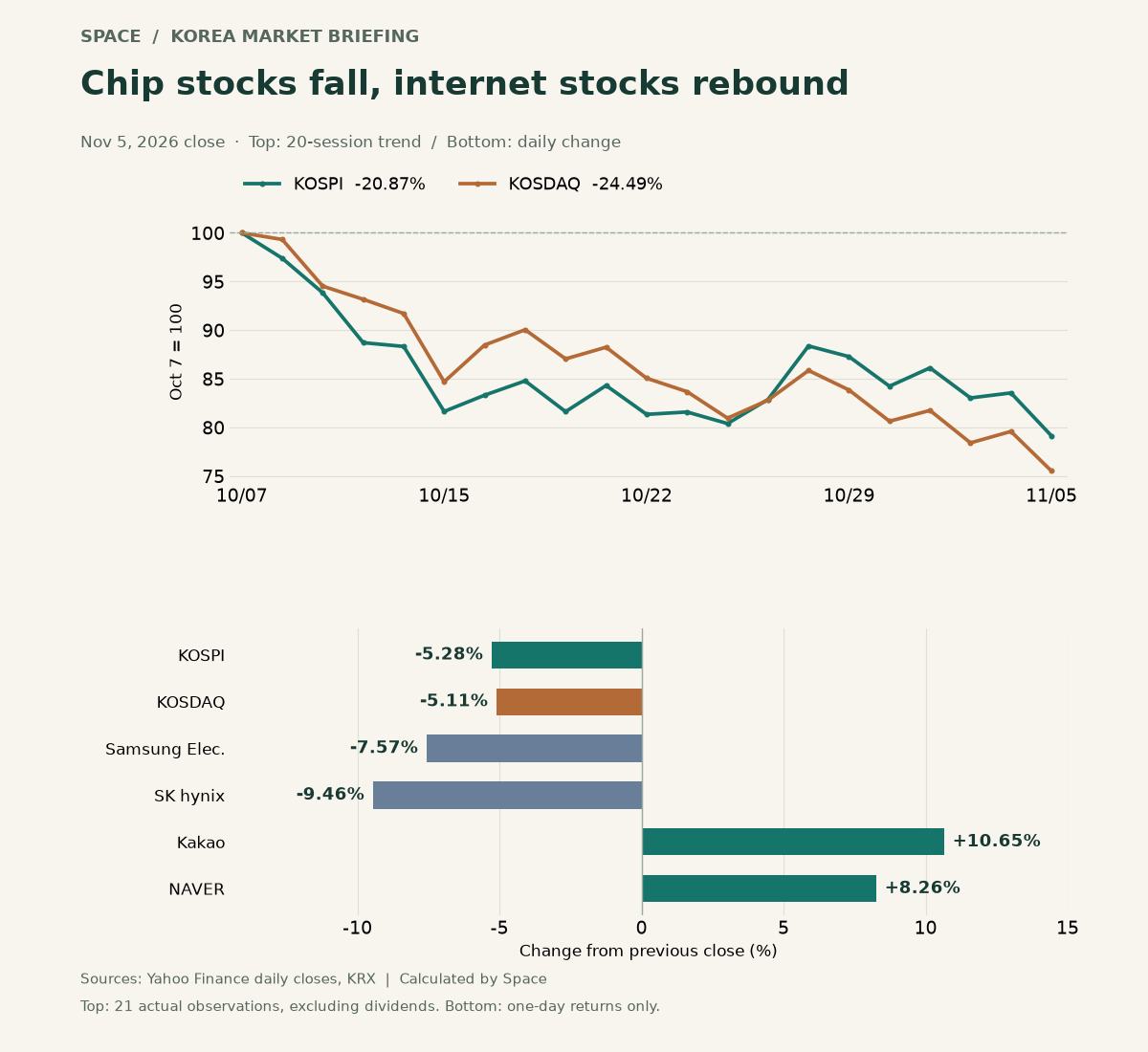
The upper panel connects 21 observed closes, rebased to October 7 = 100, with trading sessions equally spaced. It measures price changes and excludes dividends. The lower panel shows only today's returns. Keeping those time horizons separate helps prevent a single rebound in internet stocks from becoming a claim about a lasting market recovery.
Both broad indexes have lost roughly 10% in five trading sessions. Their twenty-session declines are larger still. Today's shock therefore landed on a market that was already weakening. A subsequent rebound would need to be assessed by its persistence and the number of sectors participating in it.
Why Wall Street's gain did not carry Korean chips higher
The finance ministry's market review recorded a 1.58% gain in the S&P 500 on November 4 in the United States, alongside a 3.13% decline in the Philadelphia Semiconductor Index. Industries were responding differently to possible policy changes after the US midterm elections. Korean authorities and KRX cited concern about AI regulation, data-center construction and memory demand as factors behind semiconductor weakness. The actual rules and their implementation timetable remain matters to verify. Government review · KRX session analysis
Samsung Electronics closed at KRW 201,500, down 7.57%; SK hynix finished at KRW 1,264,000, down 9.46%. When heavily weighted companies fall together, they exert substantial pressure on the index. Investors can retain a long-term interest in AI while marking down prices as they reassess near-term investment and memory orders. The full decline cannot, however, be assigned to a single policy headline. Existing weakness and selling pressure may also have contributed. Samsung daily prices · SK hynix daily prices
KRX's provisional 15:45 snapshot put foreign net selling of KOSPI shares at KRW 3.4248 trillion. Electrical and electronic stocks accounted for KRW 3.1387 trillion of net selling. That locates the concentration of selling pressure. It does not establish that a particular fund was liquidating, leaving Korea or pursuing a privately held strategy. KRX investor data
Heavy selling, different buyers
| Cash-equity market | Foreign investors | Institutions | Individuals |
|---|---|---|---|
| KOSPI | −34,248 | +8,417 | +22,769 |
| KOSDAQ | −758 | −1,029 | +1,722 |
Amounts are in KRW 100 million. Positive values mean net purchases; negative values mean net sales. Every cell uses the November 5 KRX 15:45 provisional snapshot. Only three investor groups are shown, so their sum need not equal zero. KOSPI institutional purchases included KRW 160.7 billion in the pension-fund-and-related category. That classification includes government and postal funds; it cannot be attributed to the National Pension Service alone. KRX original table
Sell-side sidecars were triggered at 10:16 on the KOSPI market and 14:27 on the KOSDAQ market. The mechanism temporarily suspends the effectiveness of program-selling orders in response to sharp futures-price moves. Alongside concentrated foreign selling and a 5.7% decline in KOSPI large caps, these are signs of considerable pressure on major stocks. Midcaps fell 0.8% and small caps 1.2%, showing that the damage was uneven. Neither a sidecar nor an index decline reveals the emotional state of every participant. KBS closing report · KRX size indexes
Kakao provided a striking example of that unevenness. It rose 10.65% to KRW 32,200, while NAVER gained 8.26% to KRW 184,900. Kakao reported third-quarter revenue of KRW 2.0867 trillion and operating profit of KRW 240.3 billion, up 6% and 7% year over year. Its board also approved a KRW 150 billion share repurchase and retirement plan, with purchases scheduled to start on November 6. The announcement did not mean the shares had already been bought that day. Earnings release · Buyback announcement · Kakao prices · NAVER prices
Investors may have distinguished between chip companies exposed to future capital spending and a business presenting current earnings and a defined shareholder-return plan. That interpretation does not guarantee further gains for internet stocks. Actual repurchase execution and earnings durability remain worth checking. For someone studying sector ETFs, the practical lesson is that two portfolios described as technology investments can behave very differently because of their constituent companies and weights.
Why the won and bonds told different stories
USD/KRW finished at 1,342.1, just 0.6 won higher. Foreign equity sales can generate dollar demand, but each sale does not automatically produce an immediate, equal-sized currency conversion. Foreign-exchange reporting described stock-related dollar buying meeting dollar sales from exporters. The DXY dollar index stood at 101.23 at 15:37 KST. DXY measures the dollar against major currencies and does not include the won. A small rise in USD/KRW can therefore coexist with broader dollar weakness. Currency close and DXY · Dealer-flow reporting
At 08:00 today, the Bank of Korea released preliminary September balance-of-payments figures. The current-account surplus was USD 61.46 billion, up from USD 46.11 billion in August. Overseas earnings provide a reason to consider support for the won. But these figures describe September activity released today; they do not mean that the entire amount arrived in the currency market this afternoon. Bank of Korea release
The same report recorded a USD 16.63 billion increase in residents' overseas portfolio investment and a USD 13.81 billion decrease in foreign portfolio investment in Korea during September. Earning dollars through trade can coexist with buying overseas assets. These are monthly transaction flows, distinct from increases in portfolio values caused by rising prices and from today's equity trading. A current-account surplus alone is therefore insufficient to predict a falling USD/KRW rate. Bank of Korea financial account
Government bond yields fell. On the Korea Financial Investment Association's 16:30 final quotation basis, the three-year yield was 3.669%, down 4.5 basis points, and the ten-year yield was 3.887%, down 8.1 basis points. One basis point equals 0.01 percentage point. Existing bond prices generally move inversely to yields, so these movements indicate stronger government-bond prices. The government highlighted reduced issuance and lower international oil prices; bond-market reporting also described demand for safer assets amid falling equities. These explanations can coexist, although their individual contributions to the day's move have not been measured here. Bond close · Government review
The finance ministry, Bank of Korea and other authorities met at 12:30 and issued their joint review at 14:00. They committed to monitoring actual policy changes and responding to greater volatility. Subsequent concrete measures will matter alongside that stated intention. Official meeting release
The next scheduled US releases are preliminary third-quarter productivity and unit labor costs at 22:30 KST on November 5, followed by the October employment report at 22:30 KST on November 6. Both are scheduled for 08:30 US Eastern Time and were still pending at this article's research cutoff. The useful questions concern how wages and productivity affect inflation pressure, and how US yields and the dollar respond. In Korea, watch whether foreign selling in chips eases and whether internet-stock gains spread to other industries. BLS release calendar
This briefing is educational. It explains market observations and their possible connections rather than recommending a trade in any security.
Sources
- https://open.krx.co.kr/contents/MKD/01/0101/01010000/MKD01010000.jsp#view=2026110511
- https://query1.finance.yahoo.com/v8/finance/chart/%5EKS11?range=3mo&interval=1d
- https://query1.finance.yahoo.com/v8/finance/chart/%5EKQ11?range=3mo&interval=1d
- https://query1.finance.yahoo.com/v8/finance/chart/005930.KS?range=3mo&interval=1d
- https://query1.finance.yahoo.com/v8/finance/chart/000660.KS?range=3mo&interval=1d
- https://query1.finance.yahoo.com/v8/finance/chart/035720.KS?range=3mo&interval=1d
- https://query1.finance.yahoo.com/v8/finance/chart/035420.KS?range=3mo&interval=1d
- https://rki.kbs.co.kr/service/news_view.htm?Seq_Code=205373&lang=e
- https://www.newsis.com/view/NISX20261105_0003856668
- https://biz.chosun.com/policy/policy_sub/2026/10/29/DECXWXBFFRFIVKUZFAXU3IL5YQ/
- https://www.ytn.co.kr/_cs/_ln_0102_202610071540346995_005.html
- https://news.einfomax.co.kr/news/articleView.html?idxno=4443308
- https://news.einfomax.co.kr/news/articleView.html?idxno=4443314
- https://www.mofe.go.kr/nw/nes/detailNesDtaView.do?menuNo=4010100&searchBbsId1=MOSFBBS_000000000028&searchNttId1=MOSF_000000000079867
- https://www.bok.or.kr/portal/bbs/B0000501/view.do?nttId=11066294&menuNo=201264
- https://www.kakaocorp.com/page/detail/12191
- https://www.kakaocorp.com/page/detail/12190
- https://www.bls.gov/schedule/2026/11_sched.htm