The closing numbers made November 4 look almost uneventful. The KOSPI gained 0.62%, while the dollar cost just half a won more than it had the previous afternoon. Anyone watching the market during the day saw something quite different: 406.41 index points separated the KOSPI’s high and low. As investors reconsidered business prospects around the US election, semiconductor shares and clean-energy stocks took different paths.
The useful story lies inside the rebound. Foreign investors sold heavily, while domestic institutions and individuals bought. Stocks finished higher and government bond yields fell. Taken together, these moves suggest investors were reconsidering which risks to hold, rather than simply becoming comfortable with every kind of risk again.
Trading session: November 4, 2026. Research cutoff: 2026-11-04 21:41 KST. Equities use the 15:30 KST KRX regular-session close; USD/KRW uses the Seoul market’s 15:30 reference. Later trading is separate.
The closing dashboard
| Measure | November 4 reading | Daily change | 5-session comparison | 20-session comparison |
|---|---|---|---|---|
| KOSPI | 5,683.80 | +0.62% | -5.47% | -18.12% |
| KOSDAQ | 714.95 | +1.50% | -7.30% | -22.28% |
| USD/KRW, won per US dollar | 1,341.50 | +0.50 won | +0.31% | -0.16% |
| Korean government bond, 3-year | 3.714% yield | -2.2bp | — | — |
| Korean government bond, 10-year | 3.968% yield | -3.3bp | — | — |
The five- and twenty-session comparisons start on October 28 and October 6. FX uses the 15:30 observations on those same KRX trading dates, not a separate count of currency-market sessions. A higher USD/KRW quote means a weaker won. One basis point is 0.01 percentage point; dashes mean no calculation is supplied. Equity closes were checked against KRX and daily prices. FX uses today’s report, October 28 and October 6. Bond yields come from the 16:40 closing report, rather than intraday indications.
1. A rebound within a much larger decline
The KOSPI opened at 5,786.13, reached 5,828.13, fell as low as 5,421.72 and finished at 5,683.80. A headline saying it rose 35.01 points leaves most of that experience out. Someone buying near the morning high faced a very different day from someone buying near the low. These are observed daily opening, high, low and closing prices.
Stepping back changes the picture again. Five sessions earlier, the KOSPI stood at 6,012.44 and the KOSDAQ at 771.28. Despite Wednesday’s gains, they remained 5.47% and 7.30% below those levels. Their twenty-session losses were larger still. One positive close therefore supplies too little evidence to establish a lasting change of direction.
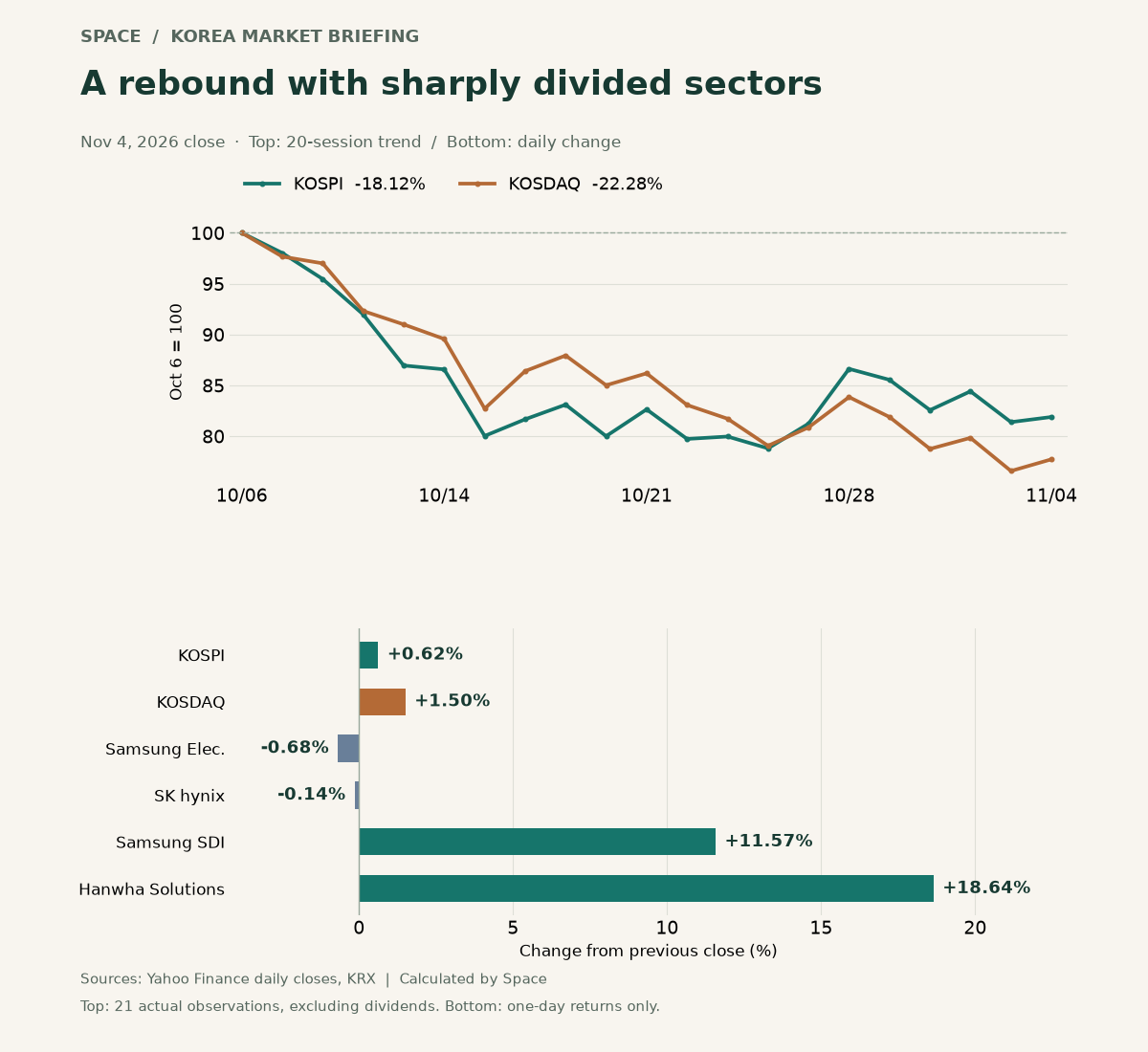
The upper panel uses 21 observed closes, rebased to 100 on October 6. Trading sessions are equally spaced, holidays are omitted and dividends are excluded. The lower panel compares only Wednesday’s returns. Keeping the two time horizons separate helps explain why a sharply rising stock can still sit inside a longer decline. Space calculated and drew the chart from KOSPI and KOSDAQ histories and the company data listed below.
Volatility alone does not establish universal panic. In KRX’s 15:45 snapshot, KOSPI turnover reached 22.5 trillion won, up 7.8 trillion won from the previous day, while large-, mid- and small-cap indexes all rose. Trading was active and the recovery crossed company sizes. Turnover, however, is not net money entering a market: every trade has a buyer and a seller. The wide price range, greater trading activity and differing investor flows together point to a mixture of relief and caution.
2. Semiconductors and clean energy read the election differently
Samsung Electronics closed at 218,000 won, down 0.68%, and SK hynix at 1,396,000 won, down 0.14%. Samsung SDI instead rose 11.57% to 545,000 won, while Hanwha Solutions gained 18.64% to 28,000 won. These are regular-session observations for Samsung Electronics, SK hynix, Samsung SDI and Hanwha Solutions.
During Seoul trading, expectations of Democratic gains in the US midterms prompted different readings of future policy. Investors considered possible constraints on data-center development alongside potential support for clean energy. MoneyToday’s closing coverage reported analysts making this distinction: slower construction could weigh on expectations for chip demand, while environmental-policy expectations could help battery and solar businesses.
A price response is not an implemented policy. Today’s trading does not establish that new restrictions have taken effect or that customer orders have been canceled. The evidence to watch is more concrete: legislation, state permitting decisions, company investment budgets and disclosed orders. Profit-taking and bargain hunting may also have contributed. A single political explanation cannot account for every transaction.
The buyer matters, too. The following table consistently uses KRX’s provisional 15:45 snapshot, avoiding a mixture of figures from reports published at different times. Positive values indicate net buying; negative values indicate net selling.
| Cash market; unit: KRW 100 million | Foreign investors | Domestic institutions | Individuals |
|---|---|---|---|
| KOSPI | -25,020 | +10,136 | +11,442 |
| KOSDAQ | -9 | +626 | -511 |
Foreign net selling on the KOSPI included 21,705 units of KRW 100 million in electrical and electronic shares, or 2.1705 trillion won. Domestic buyers absorbed substantial supply, but the index’s recovery coexisted with continued foreign selling. Within institutions, the pension-fund grouping bought a net 739 units of KRW 100 million on the KOSPI. These are observed transactions by investor class, not evidence of a particular global manager’s motives. Other investor categories are omitted, so the rows need not sum to zero. KRX source
For an ETF investor, that distinction matters. A broad-market fund and a fund concentrated in semiconductors or batteries can deliver very different experiences on the same day. Before treating a sector rally as a recovery of the whole market, it helps to understand which companies a fund actually holds and how concentrated those holdings are.
3. A quiet FX close concealed movement in the dollar and yields
USD/KRW stood at 1,341.50 at 15:30, up 0.50 won. Yet Yonhap’s FX report recorded 1,347.20 at 09:09 and 1,336.10 at 11:48—a range of 11.10 won behind the almost unchanged afternoon reading. The quote was above 1,337.30 five KRX sessions earlier, but slightly below 1,343.60 twenty sessions earlier. The won’s change over that longer comparison was much smaller than the equity market’s decline.
The same report, published at 16:27, cited the dollar index at 101.539, down 0.187 against its comparison reference. That measures the dollar against a basket of major currencies. USD/KRW measures one pair. Broad dollar weakness can therefore coexist with a small rise in USD/KRW as local currency demand and other transactions differ. Foreign equity selling also does not prove that every won of proceeds was immediately converted into dollars.
Government bonds strengthened. The three-year yield fell from 3.736% to 3.714%; the ten-year fell from 4.001% to 3.968%. For a bond with fixed payments, paying a higher price reduces the return available to its buyer. That is why falling yields are described as a stronger bond market. Closing yields
Yonhap Infomax’s bond reporting discussed expectations of constraints on US fiscal expansion and concerns about slower AI investment as possible contributors. It also presented a counterargument: both parties favor spending in different areas. A different Congress does not automatically mean smaller deficits. Whether lower yields persist depends on actual policy and economic developments. Nor does a decline in traded bond yields establish a new Bank of Korea policy-rate cut. Long-duration bond ETFs can face price pressure if yields subsequently rise.
4. Newly published reserves are not money that arrived today
On November 4, the Bank of Korea reported end-October foreign-exchange reserves of US$443.16 billion, an increase of US$2.60 billion from September’s month-end. It identified income on foreign-currency assets and greater foreign-currency deposits from financial institutions as principal contributors. The publication date is today; the measurement date is the end of last month. BOK release
Reserves are a stock of external reserve assets. Their monthly change is not today’s foreign buying of Korean stocks, nor a direct measure of the authorities’ net currency purchases. Income and deposits can change the balance without representing either of those things. The release also does not establish that reserves caused Wednesday’s equity rebound.
This is a useful distinction for reading financial news. Equity flows describe transactions over a period. Reserves describe a balance at a point in time. An analyst’s outlook describes possible future events. Treating all three as the same kind of money movement can turn a useful statistic into a misleading market story.
What to watch next
In Korea’s November 5 session, watch whether selling pressure on chips eases, whether battery and solar gains persist, and whether foreign and domestic institutional flows become less divided. Higher closing prices accompanied by continuing large intraday swings would still leave questions about the stability of sentiment.
The US Bureau of Labor Statistics schedules preliminary third-quarter productivity and costs for November 5, followed by October’s employment report on November 6. Both are scheduled for 08:30 US Eastern time, or 22:30 KST on the same calendar day. Productivity, labor costs and hiring will offer another test of interest-rate expectations. Their unreleased results cannot be used as established explanations for today’s prices. Official BLS calendar
The habit worth keeping is to attach a time horizon to each number: a daily bounce versus a multiweek trend, an election expectation versus enacted policy, a transaction versus an asset balance. Those distinctions make a complicated market easier to read. This briefing is educational market commentary, not a recommendation to trade a particular product.
Sources and methods
- KRX November 4 market brief: 15:45 snapshot, posted at 15:46; closes, cash flows, turnover and sectors.
- Yahoo Finance: KOSPI, KOSDAQ, Samsung Electronics, SK hynix, Samsung SDI and Hanwha Solutions; daily regular-session prices and original calculations.
- Yonhap November 4 FX, YTN October 28 close and Newspim October 6 close: comparable 15:30 Seoul currency observations.
- Yonhap/Maeil closing yields, Infomax bond analysis and MoneyToday sector reporting: observed prices separated from attributed interpretations.
- Bank of Korea reserves and BLS November calendar: release dates, reference periods and scheduled times.
krx: 15:45 집계, 15:46 게시. 주식 종가·현물 수급·거래대금·업종 확인.
- Yahoo Finance 코스피, 코스닥, 삼성전자, SK하이닉스, 삼성SDI, 한화솔루션: 일별 정규장 가격, 5·20거래일 변화와 차트 계산.
- 연합뉴스 11월 4일 환율, YTN 10월 28일 마감, 뉴스핌 10월 6일 마감: 서울 15:30 환율 비교.
- 연합뉴스·매일경제 마감 금리, 연합인포맥스 채권 취재, 머니투데이 업종 취재: 마감 수치와 시장 참여자의 해석을 구분해 사용.
- 한국은행 10월 말 외환보유액, BLS 11월 발표 일정: 발표일·관측 기간·예정 시각 확인.
Sources
- https://open.krx.co.kr/contents/MKD/01/0101/01010000/MKD01010000.jsp#view=2026110411
- https://query1.finance.yahoo.com/v8/finance/chart/%5EKS11?range=3mo&interval=1d
- https://query1.finance.yahoo.com/v8/finance/chart/%5EKQ11?range=3mo&interval=1d
- https://query1.finance.yahoo.com/v8/finance/chart/005930.KS?range=3mo&interval=1d
- https://query1.finance.yahoo.com/v8/finance/chart/000660.KS?range=3mo&interval=1d
- https://query1.finance.yahoo.com/v8/finance/chart/006400.KS?range=3mo&interval=1d
- https://query1.finance.yahoo.com/v8/finance/chart/009830.KS?range=3mo&interval=1d
- https://www.yna.co.kr/view/AKR20261104141900002
- https://www.ytn.co.kr/_ln/0102_202610281536270007
- https://www.newspim.com/news/view/20261006001192
- https://stock.mk.co.kr/news/view/1189107
- https://news.einfomax.co.kr/news/articleView.html?idxno=4443033
- https://www.mt.co.kr/stock/2026/11/04/2026110416173774884
- https://www.bok.or.kr/portal/bbs/B0000502/view.do?depth=201265&menuNo=201265&nttId=11066257&programType=newsData&relate=Y
- https://www.bls.gov/schedule/2026/11_sched.htm