A little after the opening bell, trading stopped. At 9:03:33 a.m. on November 6, a circuit breaker was triggered in Korea’s KOSPI market, interrupting trading for twenty minutes. The pause gave participants time to reassess their orders. It did not turn the day into an exchange holiday: trading resumed, and the KOSPI finished at 5,059.69. Read together, the intraday report and the exchange’s closing brief raise a question beyond the size of the loss. Why did selling concentrate in chip stocks while the won weakened and government bonds gained?
Trading session: November 6, 2026, Korea regular session. Research cutoff: November 6, 2026, 21:44 KST. Equities use the 15:30 close; USD/KRW uses the 15:30 daytime close. Investor flows are the KRX provisional snapshot at 15:45; bond yields come from a separate afternoon closing report. Subsequent overnight FX trading and the November 6 US regular session are excluded.
Put the day beside the recent trend
| Indicator | November 6 close | One session | Five sessions | Twenty sessions |
|---|---|---|---|---|
| KOSPI | 5,059.69 | −6.02% | −11.71% | −23.64% |
| KOSDAQ | 644.27 | −5.03% | −11.06% | −27.79% |
| USD/KRW, won per dollar | ₩1,356.6 | +₩14.5, +1.08% | +1.67% | +1.35% |
Five-session changes compare with October 30; twenty-session changes compare with October 8. Index calculations use daily KOSPI and KOSDAQ observations, with today’s closes checked against KRX. FX comparisons join the November 6 report, the October 30 observation in the government release and the October 8 daytime close. A higher USD/KRW quote means more won are needed to buy one dollar.
The KOSPI suffered the larger daily loss, but the KOSDAQ fell further across twenty sessions. Today’s shock to large chip companies landed on top of an existing, broader decline. Saying that the KOSPI held 5,000 tells us little about those accumulated losses. Equally, the twenty-session decline must not be mistaken for a single day’s move.
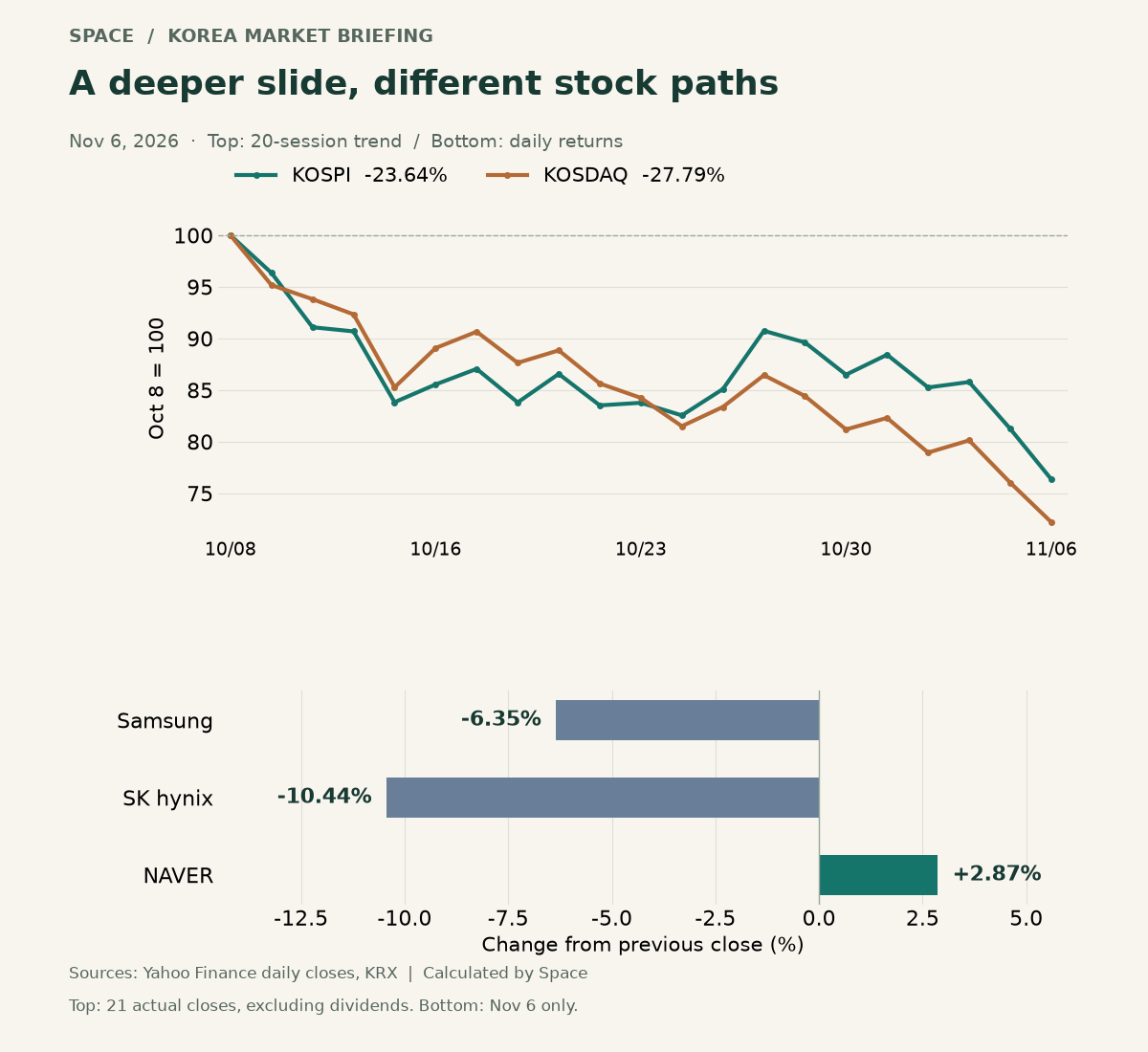
The upper panel uses twenty-one observed closing prices, rebased to 100 on October 8. Trading sessions are equally spaced and dividends are excluded. The lower panel compares individual stocks on November 6 alone. The two panels answer different questions. No missing daily FX observations have been filled in to manufacture a currency trend line.
The reassessment began with chips
Before Korea opened, the November 5 US session had left the S&P 500 down 4.36% and the Philadelphia Semiconductor Index down 12.25%. Korean authorities and KRX identified concern about AI data-center regulation and weaker risk appetite as contributing factors. That describes a response to policy uncertainty; it does not establish that all data-center construction stopped or that Korean suppliers suffered equivalent confirmed order cancellations. Government statement; KRX commentary.
Samsung Electronics closed at ₩188,700, down 6.35%, and SK hynix at ₩1,132,000, down 10.44%. Over five sessions, their declines were 16.13% and 20.17%, respectively. Those sequences suggest an ongoing repricing rather than an isolated weak afternoon. NAVER went the other way, gaining 2.87% to ₩190,200. The divergence alone cannot show that proceeds from chip-stock sales all moved into NAVER.
A share price reflects both earnings already delivered and earnings investors expect in the future. Doubts about the pace or durability of AI investment can change the price investors will pay for those future profits even without a fresh earnings announcement. Actual changes in customer orders and capital-spending schedules therefore need to be separated from concerns reflected in prices. Subsequent company disclosures will help establish whether demand and investment plans remain intact.
For readers holding an index or semiconductor ETF, the practical starting point is its composition. Owning several companies does not automatically remove a large exposure to one industry. Check actual portfolio weights before attributing a fund’s performance to a market story. This briefing does not infer a particular ETF’s return or investor inflows from a few constituent moves.
Stress was broad, but investor groups did not move uniformly
Market breadth adds information that an index level cannot provide. A closing report counted 760 declining KOSPI stocks, 131 advancers and 20 unchanged, out of 911. Alongside the trading interruption, that broad decline supports an interpretation of strong risk aversion. The presence of advancing stocks still matters: it prevents a claim that every asset and investor expressed the same judgment. Closing breadth report.
| Net purchases on November 6, KRW 100 million | Foreign investors | Institutions | Individuals |
|---|---|---|---|
| KOSPI cash equities | −27,685 | +17,000 | +6,046 |
| KOSDAQ cash equities | −1,013 | +2,055 | −1,103 |
| KOSPI 200 futures | +10,698 | −8,898 | −1,843 |
Source: KRX provisional figures at 15:45 KST. Negative values mean net sales; positive values mean net purchases. Other participant categories are omitted, so the three columns need not sum to zero. Reports using a different collection time can show slightly different amounts.
The contrast between foreign cash-equity selling and futures buying deserves attention. “Foreign investors” combines participants with different strategies. Futures activity can include closing existing positions or adjusting risk. These aggregate numbers cannot establish that foreigners confidently expected a rebound, or that a particular global fund had abandoned Korea. Futures trading amounts are not the margin cash deposited, and they should not simply be offset against cash-equity net sales.
Institutional purchases absorbed some selling, yet the index still closed sharply lower. That is an observed outcome. Whether the buyers’ long-term assessment proves right, or whether their trades were short-term position adjustments, remains unknown. In the next session, easing foreign cash selling and a wider population of advancing stocks would provide more useful evidence than the headline index alone. A rebound confined to a few heavyweights would have a narrower foundation.
The won and government bonds took different paths
USD/KRW rose from the previous daytime close of ₩1,342.1 to ₩1,356.6. Demand for dollars after foreign equity sales is one plausible channel linking stocks and the currency. It is not evidence that every won of sale proceeds was converted that day. The FX report also identified exporters’ dollar sales as a restraint on the exchange rate’s rise. Equity selling, potential dollar demand and export-receipt conversions can coexist in the same market. FX closing report.
That report put DXY at 101.80 at 15:25 KST. DXY and USD/KRW measure different things: DXY compares the dollar with a major-currency basket that does not include the won. The 1.08% daily rise in USD/KRW cannot be relabeled as a 1.08% worldwide gain for the dollar. Here the DXY level is a timestamped reference, without manufacturing a daily return from observations taken at mismatched times.
Government bonds showed a different price response. In the afternoon closing report, the three-year Korean government yield fell 5.6 basis points to 3.613%, while the ten-year fell 3.4 basis points to 3.853%. One basis point is 0.01 percentage point. Prices of existing fixed-rate bonds generally rise when their yields fall. Bond strength alongside falling equities is consistent with demand for safer assets, although yields alone do not identify the buyers or prove their motives. Bond closing data.
The same report showed a 4.313% yield on three-year unsecured AA− corporate debt. Its spread over the matching government maturity widened from 68.9 to 70.0 basis points, an increase of 1.1 basis points. Corporate yields fell, but by less than government yields. That modest widening is insufficient to diagnose a credit crisis. It does show why relief in government bonds is not identical to a broad improvement in corporate financing conditions. A decline in market yields is also distinct from an announced Bank of Korea policy-rate cut.
The government is addressing a forced-selling chain
Following a 10:30 interagency meeting, an 11:30 government release announced a three-month exemption from brokers’ 140% margin-loan collateral-maintenance requirement, effective November 9. The Bank of Korea participated. Further stabilization measures were described as conditional on greater volatility, rather than additional money already deployed. Joint official release.
When shares purchased with borrowed money fall, their collateral value shrinks. Accounts unable to restore sufficient collateral can face liquidation. Those sales can push prices lower and put pressure on other accounts. The measure aims to soften that feedback loop. It does not mean every customer’s forced sale automatically disappears or that loan repayment obligations vanish. The practical application needs to be checked against subsequent brokerage notices.
The continued market decline after the announcement and the policy’s eventual effect are separate questions. A closing price before implementation cannot settle whether the measure works. Nor does the announcement guarantee a floor under share prices. The next sessions will offer evidence about selling pressure and whether any recovery reaches beyond a few semiconductor names.
At this briefing’s cutoff, the US October employment report had not been released. The BLS calendar schedules it for November 6 at 08:30 EST, or 22:30 KST tonight. October consumer prices are scheduled for November 10 at the same times. Employment, wages and inflation can alter the response of yields and the dollar. Even a stronger-than-expected result does not preordain the direction of stocks: the actual bond and currency reactions need to be observed together.
This session brings together semiconductor repricing, broad risk aversion, a weaker won, stronger government bonds and a policy response due to begin next week. The purpose of this briefing is to explain those relationships, rather than recommend trades in individual securities.
Sources and calculation notes
- KRX November 6 closing brief and 15:45 provisional flows, trading-interruption report and closing market breadth.
- Daily regular closes for KOSPI, KOSDAQ, Samsung Electronics, SK hynix and NAVER, October 8 through November 6; calculations and charts by Space.
- November 6 daytime FX close and 15:25 DXY, October 8 daytime FX close. The October 30 FX observation comes from the government release.
- Government measure and effective date, afternoon bond yields and BLS November release calendar.
Sources
- https://query1.finance.yahoo.com/v8/finance/chart/%5EKS11?range=3mo&interval=1d
- https://query1.finance.yahoo.com/v8/finance/chart/%5EKQ11?range=3mo&interval=1d
- https://query1.finance.yahoo.com/v8/finance/chart/005930.KS?range=3mo&interval=1d
- https://query1.finance.yahoo.com/v8/finance/chart/000660.KS?range=3mo&interval=1d
- https://query1.finance.yahoo.com/v8/finance/chart/035420.KS?range=3mo&interval=1d
- https://open.krx.co.kr/contents/MKD/01/0101/01010000/MKD01010000.jsp#view=2026110611
- https://stock.mk.co.kr/news/view/1192116
- https://www.opinionnews.co.kr/news/articleView.html?idxno=146788
- https://www.newsis.com/view/NISX20261106_0003858210
- https://www.mt.co.kr/economy/2026/10/08/2026100815360412966
- https://www.korea.kr/briefing/pressReleaseView.do?newsId=156788234&pWise=sub&pWiseSub=C1
- https://stock.mk.co.kr/news/view/1192450
- https://www.bls.gov/schedule/2026/11_sched.htm