Wanting dividends now and room for share-price growth later is reasonable. Wanting the maximum of both without a trade-off is a different proposition. DIVO approaches the trade-off selectively: it chooses stocks and decides where to add covered calls rather than treating every holding in exactly the same way.
The Amplify CWP Enhanced Dividend Income ETF combines company dividends with an additional source of cash from options. How much exposure is covered, and which stocks are involved, matters as much as the monthly payment schedule.
Two investment decisions in one fund
DIVO actively selects US large-cap companies with attention to dividend and earnings growth. Its issuer describes tactical covered-call writing on individual stocks. It is better understood as a combination of stock selection and option decisions than as a uniform overlay on the entire market.
The current issuer page reviewed in October 2026 lists annual total expenses of 0.56%, replacing the 0.55% figure in the earlier introduction. At September 30, 2026, its stated annualized distribution rate was 4.88%, while its 30-day SEC yield was 1.40%. Those measures answer different questions and cannot be substituted for each other.
| Reading order | What to inspect |
|---|---|
| Equity portfolio | Selected US large-cap dividend stocks |
| Options | Tactical calls on individual holdings |
| Annual total expenses | 0.56% |
| Payments | Monthly, with variable amounts |
| Performance | Total return, including treatment of distributions |
“Selective” should not be converted into a permanent promise that no more than a fixed 20% is covered. Positions and decisions can change. The current option book and prospectus are more useful than an old percentage repeated without its context.
What the premium buys, and what it costs
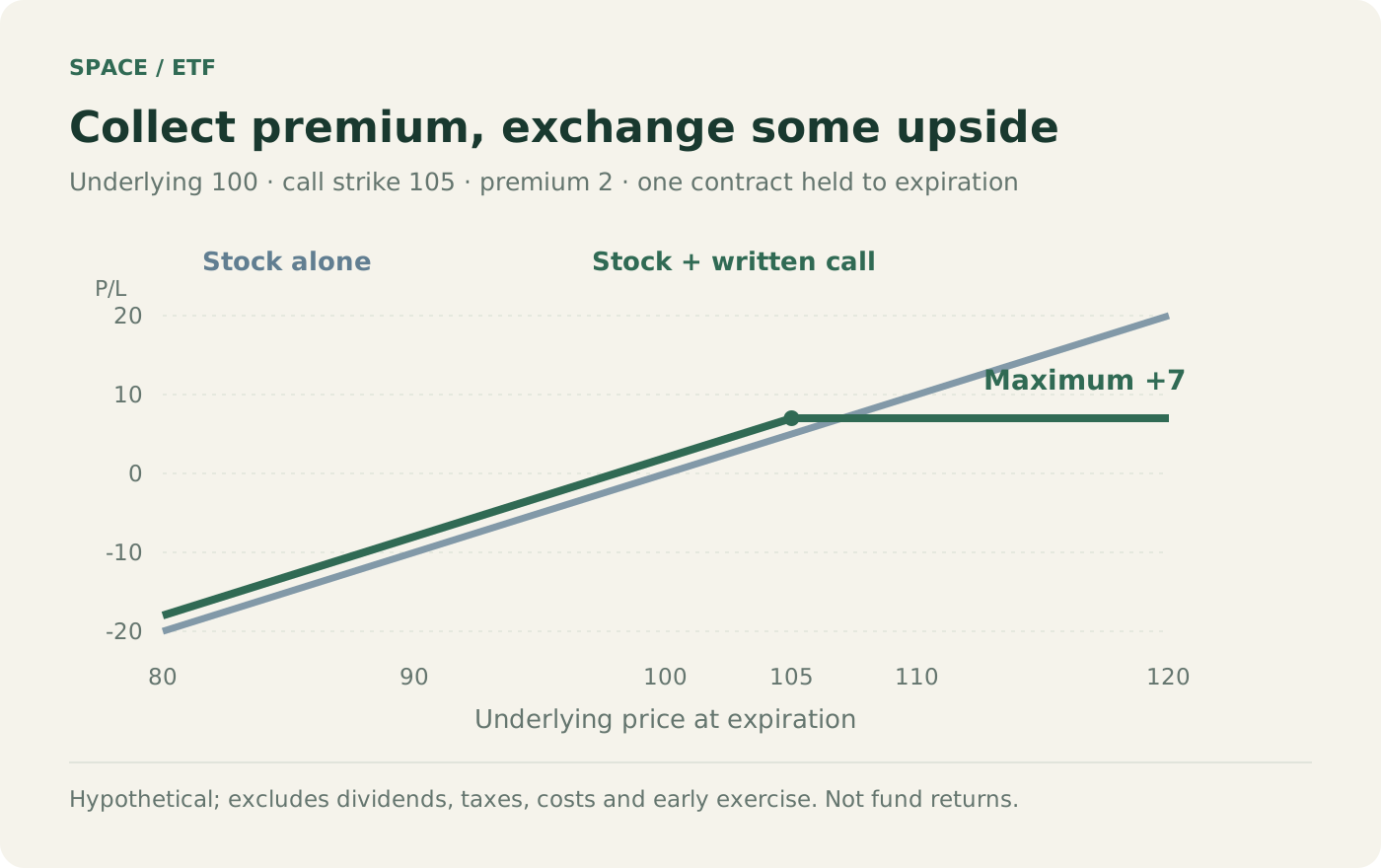
Imagine owning a stock at 100 and receiving a premium of 2 for granting someone the right to buy it at 105 at a stated expiration. If the stock finishes at 103, the stock's gain and the premium both help. If it finishes at 120, the written option gives away part of the upside.
 View full-size figure (new tab) ↗
The diagram is a single-option teaching example held to expiration. It does not reproduce DIVO's actual trading, costs or taxes. Uncovered holdings behave differently, and changing contracts during the period changes the result.
Now imagine the stock falling to 80. The premium softens the loss, but it does not erase it. That distinction is central to the strategy. A modest cushion is not capital protection, and a regular distribution is not proof that the investment avoided a loss.
Selection also means concentration
A smaller set of chosen stocks can benefit more visibly from good decisions than a broad portfolio holding hundreds of companies. It can also suffer more visibly from mistakes in company or sector selection. Calling a business high quality does not settle whether its price or portfolio weight is appropriate.
Compare current holdings with the investments you already own. If your portfolio already contains large US financial and technology positions, DIVO may add less diversification than a new ticker suggests. Overlap is not automatically wrong, but it should be intentional.
Let the available history set the claim
DIVO launched on December 14, 2016. As of this article's October 22, 2026 review, it had not completed ten full years. A claim of an actual trailing ten-year ETF return would therefore need careful scrutiny. A related strategy's earlier track record is not the same as the ETF's own live history.
Likewise, a projection repeating an annual price gain and distribution rate is an assumption exercise. It should not be presented as the fund's expected path. An investor who spends every payment cannot use a fully reinvested performance chart as an unchanged forecast of the ending account balance.
When assessing DIVO, ask whether stock selection and selective option management justify their costs for the role you want the investment to play. Then ask whether concentration and lost upside are acceptable trade-offs. The payment arriving each month becomes one item in that review, rather than the whole explanation for owning the fund.
Sources and dates
Reviewed on October 22, 2026. Observations belong to the dates stated in the text. Distributions and expenses can change.