An investor can want to own growing businesses for a long time and still need cash today. Selling shares feels uncomfortable when those businesses might rise further. Switching entirely to mature dividend payers changes the investment. QDVO addresses that tension by combining a growth-stock portfolio with options.
It does not make the tension disappear. Cash received from selling options has an economic counterpart. Understanding that exchange is more useful than beginning with the highest distribution number on the screen.
Start with the objective
The Amplify CWP Growth & Income ETF describes capital appreciation as its primary objective and high current income as secondary. It selects large-cap growth equities and can use tactical covered calls on individual stocks and, at times, broad market indexes. It should not be treated as a simple Nasdaq-100 tracker.
The reviewed issuer page lists total annual expenses of 0.56% and monthly distributions. That updates the earlier 0.55% figure. The earlier description of a permanently fixed option limit should also not be treated as a contractual feature without checking the current prospectus and actual positions.
| Item | Official observation |
|---|---|
| Total annual expenses | 0.56% |
| Launch | August 2024 |
| Payment schedule | Monthly |
| Annualized distribution rate | 11.19%, September 30, 2026 |
| 30-day SEC yield | 0.39%, same date |
| Strategy | Selected growth stocks with tactical call options |
The difference between the two yield measures is not automatically an error. Option-related cash and the classification of distributions interact differently with different measures. A distribution rate should not be translated into a statement that the fund earned that percentage as an investment return.
Options sit on top of equity risk
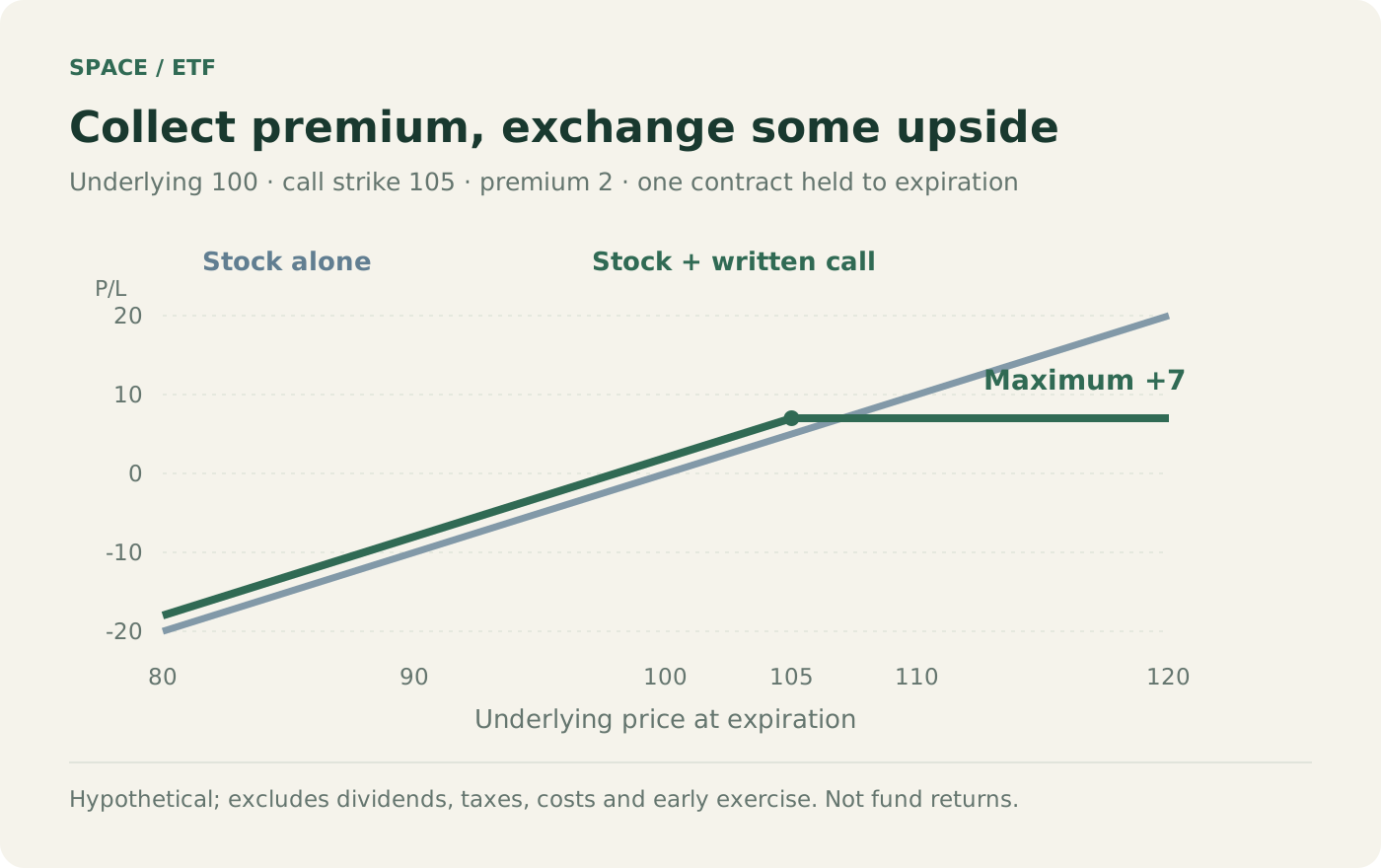
Growth-stock prices often reflect substantial expectations about future earnings. Changes in rates or business expectations can produce large price movements. Receiving call premiums does not eliminate that underlying risk. A large cash payment and a small capital loss are separate questions.
 View full-size figure (new tab) ↗
Uncovered holdings retain their own upside, while written calls can reduce gains on the exposure they cover. The ability to adjust an overlay gives the manager flexibility. It does not prove that each adjustment will turn out well. Whether a particular decision helped becomes clearer only after the market has moved.
Count the weights, not just the names
An ETF can hold dozens of securities and still depend heavily on its largest positions. It can also overlap with other growth funds in the same account. Owning two tickers in equal proportions does not mean the economic risks have been divided into two independent halves.
Add the weights of the largest five equity holdings, then compare those names with any Nasdaq or technology funds you already own. The exercise turns a general concern about concentration into a concrete portfolio question. “Growth plus income” does not mean the same thing as “stocks plus cash.”
This also explains why a fund's number of reported positions needs context. Cash and option positions can appear beside stocks in a holdings file. A count alone may tell less about equity diversification than the actual weights and the exposures represented by derivatives.
A short record leaves unanswered questions
Launched in August 2024, QDVO had not experienced a long sequence of complete market cycles by this October 2026 review. There is no actual five- or ten-year ETF performance history to report. Filling those empty columns with another index or an invented annual return would blur the evidence.
Multiplying the latest distribution by twelve to set next year's spending budget creates a similar problem. Market conditions and distribution decisions can change. Someone spending the cash should first test a reduced-payment scenario. Someone reinvesting should compare total returns over matching dates.
Published NAV returns generally already reflect the fund's expenses. Subtracting those expenses again can double count them. Personal taxes and currency conversion costs, however, are not automatically included. Read the definition of the performance measure before doing more arithmetic.
QDVO is a particular way to hold growth exposure while receiving cash along the way. Its equity risk, option opportunity cost and limited operating history belong in the same decision. Once those are visible, the investment can be described more accurately than simply “getting growth and dividends at once.”
Sources and dates
Reviewed on October 22, 2026. Observations belong to the dates stated in the text. Distributions and expenses can change.