Monthly money arriving in an account can sound like bank interest. Add the phrase “lower volatility,” and the investment may feel safer still. JEPI is easier to understand if we pause that association. Its cash comes from a different set of assets and contracts.
The fund carries equity and derivative exposure. It seeks income and lower volatility, but an investment objective is not a guarantee of the outcome. Understanding the mechanism helps explain what each payment does—and does not—represent.
Stocks and equity-linked notes
The JPMorgan Equity Premium Income ETF selects US large-cap stocks and combines them with option-related income. An important part of the structure is the use of equity-linked notes, or ELNs. These are structured securities issued by financial institutions and can provide exposure to option-related cash flows.
“Note” should not be read as “safe government bond.” Issuer credit, valuation and liquidity risks enter the picture. Reducing JEPI to the sentence “it owns good stocks and sells calls” leaves out a meaningful part of the structure.
| Item | Basic information reviewed |
|---|---|
| Ticker | JEPI, the US-listed ETF |
| Launch | May 20, 2020 |
| Gross and net annual expenses | 0.35% each |
| Equity approach | Selected US large caps, seeking lower volatility |
| Additional income exposure | Options accessed through ELNs |
| Payments | Monthly, without a guaranteed amount |
The structure and expenses were checked against issuer information available in 2026. Similar names on European exchanges do not necessarily identify the same legal fund. Compare the actual domicile and share class before carrying facts from one product to another.
Lower volatility is not the absence of loss
Volatility describes fluctuations. A portfolio moving less than the market during one period does not establish a permanent limit on future losses. Selected stocks can decline sharply, and option income may cover only a small part of the fall.
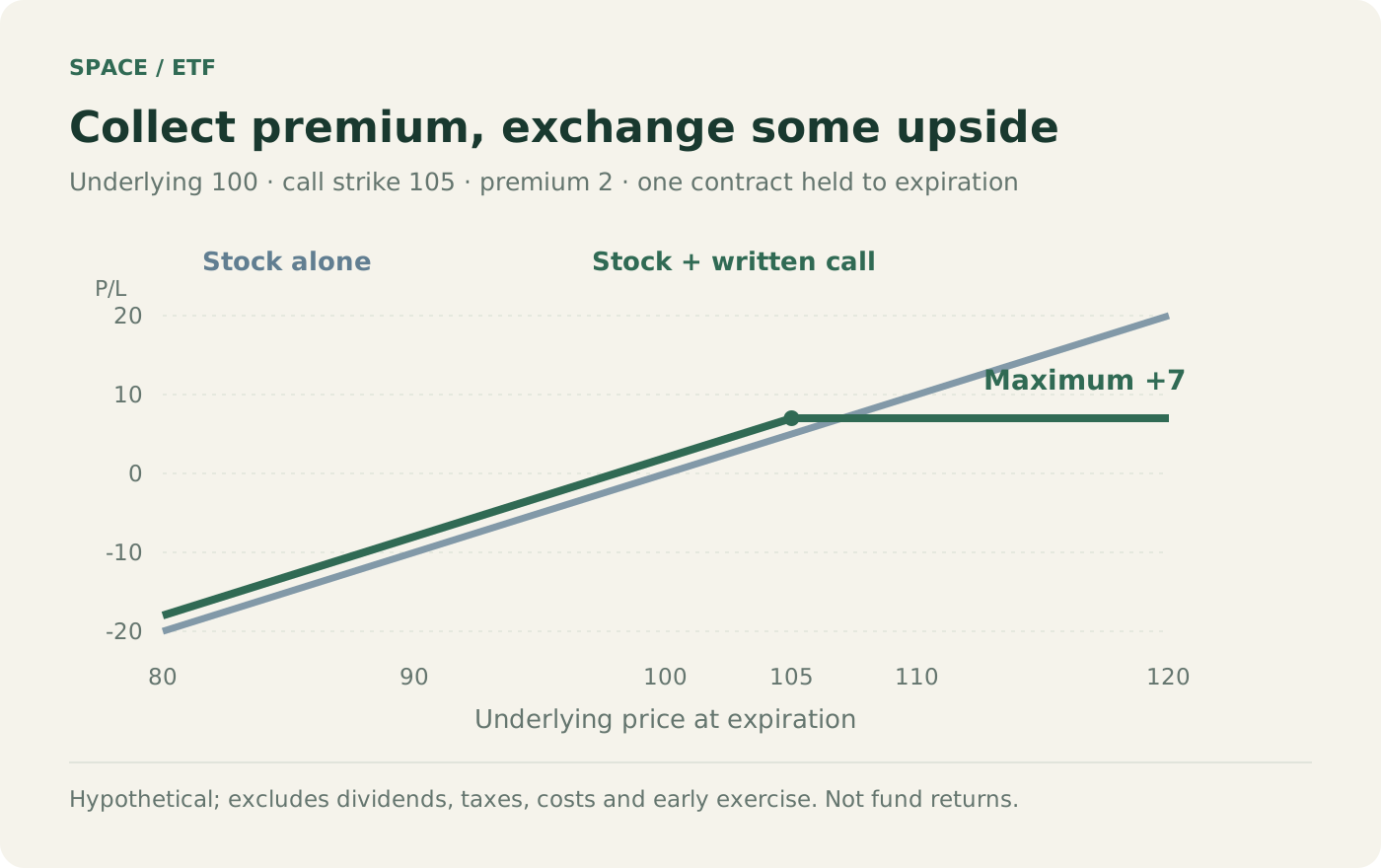
In a rapidly rising market, the overlay and stock selection can also leave the fund behind. That is one way the trade-off for current income becomes visible. Expecting all the market's upside plus a large additional cash payment ignores the exchange embedded in the strategy.
 View full-size figure (new tab) ↗
This diagram explains a general option mechanism. It is not a model of JEPI's actual ELN contracts, weights or performance. The real structure adds contractual and counterparty considerations that a simple payoff line cannot show.
What “this month times twelve” leaves out
Multiplying a recent payment by twelve is a quick annualization. It assumes repetition. Market volatility, option terms, corporate dividends and investment results can change. Nor does a single indicator such as the VIX mechanically determine the next payment.
Keep a distribution measure and a total-return measure on separate lines. If an invented investment starts at 1,000, pays 80 and ends with 900 still invested, its simple combined result is negative 20. “It paid 8%” is true within the example but incomplete. These are teaching numbers, not JEPI's reported results.
A household that budgets around the largest monthly distribution has little room for disappointment. Someone relying on income should consider a reduced-payment case and maintain an appropriate separation between spending reserves and equity investments. A fund does not become emergency cash because it distributes regularly.
Compare like with like
When comparing JEPI with a broad equity benchmark, align starting and ending dates and the treatment of reinvestment. A price-only chart and a reinvested total-return chart answer different questions. If lower volatility motivated the investment, examine drawdowns and the recovery path as well as the ending return.
Identical expense ratios do not imply identical investment strategies. Two funds charging 0.35% can select different stocks and use different instruments. Personal taxes and currency-conversion costs can also make the amount received differ from an issuer's dollar-based illustration.
JEPI can be described as a way of accepting equity risk and structural complexity while exchanging part of the growth opportunity for current income. That is less dramatic than claiming an impenetrable defense against falling markets. It is also a more useful description when the account actually falls.
Sources and dates
Reviewed on October 22, 2026. Observations belong to the dates stated in the text. Distributions and expenses can change.