An investor can admire growing technology businesses and still wish they paid more cash. A fund promising a monthly distribution alongside growth-stock exposure is therefore easy to notice. JEPQ deserves a closer reading: it does not add a free interest payment on top of unrestricted equity returns.
Separate the stocks from the income mechanism. Large distributions can coexist with substantial growth-stock risk, and a shared manager does not make JEPQ and JEPI interchangeable.
Nasdaq-related is not a perfect replica
The JPMorgan Nasdaq Equity Premium Income ETF uses an actively managed US equity portfolio with a growth orientation and the Nasdaq-100 as an important benchmark. Its allocation process and option-related income distinguish it from a fund simply replicating every index weight.
Equity-linked notes are part of the explanation. ELNs issued by financial institutions can provide option-related exposure, bringing issuer-credit and liquidity considerations alongside equity risk. This is a different source of cash from merely collecting company dividends.
| Item | Basic information reviewed |
|---|---|
| US-listed ticker | JEPQ |
| Launch date | May 3, 2022 |
| Gross and net annual expenses | 0.35% |
| Equity approach | Active allocation with large-cap growth exposure |
| Income structure | Company dividends and ELN-related option exposure |
| Payment schedule | Monthly, subject to variation |
The facts above were checked against the issuer's 2026 fact sheet and fund explanation. Rapidly changing prices and asset totals are not presented as live data without a reporting date. Structure and expenses provide a more durable starting point.
Reading a larger payment carefully
Growth-oriented stocks can carry different expected volatility from a broader low-volatility portfolio. Option pricing can therefore differ, contributing to differences in distributions. This does not establish that JEPQ will always pay more, or that a higher payment makes it the better investment.
Ask which gains might be surrendered in a strong rally and which holdings might drive losses during a decline. Two products seeking current income can expose the investor to quite different equity outcomes.
| Question | JEPI | JEPQ |
|---|---|---|
| Equity emphasis | US large caps, seeking lower volatility | Large-cap growth and Nasdaq-related exposure |
| Existing holdings to compare | Broad US and dividend positions | Nasdaq and technology positions |
| Income review | ELNs and variable distributions | The same questions plus growth concentration |
Holding both does not eliminate shared US equity, dollar or large-company exposures. Buying different tickers and acquiring independent sources of risk are different achievements. Actual holdings are the place to check.
Do not let cash hide a capital loss
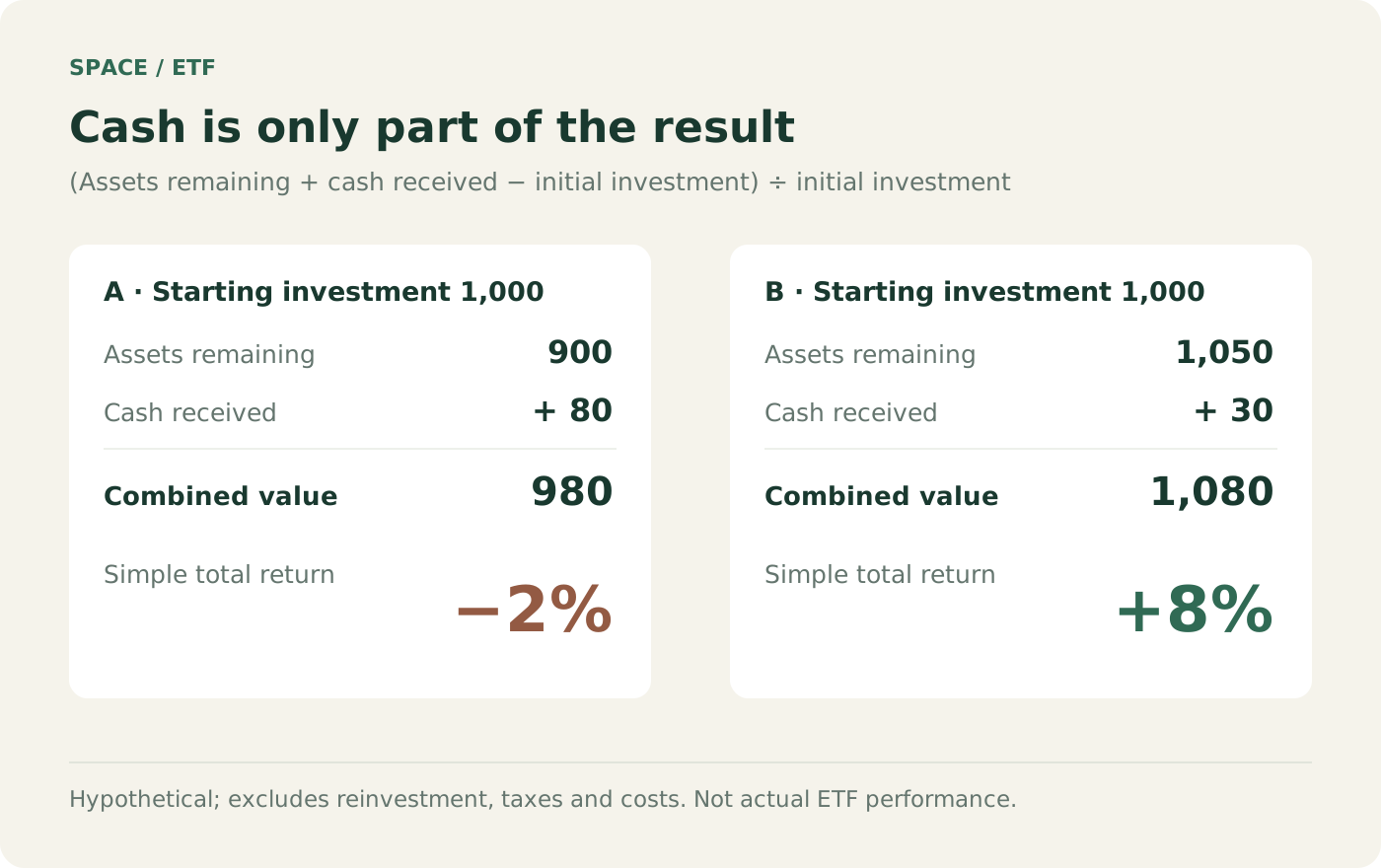
Imagine investing 1,000, receiving 100 during the year and ending with 850 still invested. Adding the cash gives 950, a simple pretax loss of 50. The distribution helped the combined outcome, but it did not make the investment profitable. These are teaching assumptions, not JEPQ's historical returns.
 View full-size figure (new tab) ↗
The reverse can also occur: a smaller distribution can accompany a stronger remaining asset value. Distribution rate, reinvested total return and drawdown answer separate questions. Calling all three “yield” makes the analysis less clear rather than simpler.
Someone spending distributions should evaluate a reduced-payment scenario. Someone reinvesting should ask whether the total-return trade-off suits the objective. Both investors should distinguish the official fund performance from their personal result after taxes, execution prices and currency conversion.
Write down what growth means to you
If the aim is to retain as much long-term Nasdaq upside as possible, an option-income strategy and an ordinary index fund represent different choices. If current cash is genuinely useful, giving up some upside may be an acceptable exchange. The right question depends on the job the money must do.
JEPQ launched in 2022. Its live history should not be extended backward by quietly attaching index returns or assumptions. Repeating a recent payment rate for fifteen years also creates a projection, not evidence about what the fund will deliver.
For a reader spending in won, dollar distributions add a currency question. Record the expected spending need, what happens if payments shrink, and whether a market decline could force a sale. JEPQ then becomes a decision about exchanging part of growth exposure for current cash, rather than a promise to maximize both at once.
Sources and dates
Reviewed on October 22, 2026. Observations belong to the dates stated in the text. Distributions and expenses can change.