A figure near 14% invites quick arithmetic. It is easy to multiply a savings balance by that rate and imagine a monthly payment. With QQQI, however, the first task is classification: does the percentage describe a distribution, an observed total return, or a promise about the future?
QQQI is the NEOS Nasdaq-100 High Income ETF. It combines Nasdaq-100-related equities with NDX index options to seek high monthly income. A ticker resembling QQQ can suggest the same investment with extra payments attached. The option strategy changes that picture: cash is generated through a different return path, not added from outside it.
The market does not pause on payment day
The Nasdaq-100 represents large nonfinancial companies listed on Nasdaq. Technology-related businesses have substantial influence, but the index is not composed entirely of technology companies. Its number of constituents also does not tell the whole diversification story: large weights in a few companies can dominate movements.
| Item | Information reviewed |
|---|---|
| Ticker / inception | QQQI / January 29, 2024 |
| Annual expenses | 0.68% |
| Equity exposure | A Nasdaq-100-related portfolio |
| Options | Written and purchased NDX index calls |
| Payments | Monthly |
| Distribution rate | 14.28%, September 30, 2026 |
| 30-day SEC yield | -0.06%, same date |
Read the final two rows together. The distribution rate annualizes a recent payment; it is not a forecast of total return. SEC yield is a separate standardized income calculation. The measures can diverge substantially in a fund using options to support distributions. Nor does a negative SEC yield mean that the fund's overall investment return was exactly that negative amount.
These are September-end observations reviewed on October 22, 2026. Keeping the date beside the number prevents an old observation from masquerading as today's assured income. Subsequent payments and annualized rates can change.
What purchased calls cannot promise
Writing a call generates premium in exchange for giving away some potential upside. Adding a purchased call can alter the payoff in particular price ranges, but that contract has a price and specific terms. The combination cannot be summarized as unlimited appreciation plus free income.
When stocks decline, premium may cushion part of the loss. A cushion is not a capital guarantee. A large stock-market fall can overwhelm the amount collected. Participation in a later recovery also depends on the options held during that recovery, so the path matters as well as the final market level.
 View full-size figure (new tab) ↗
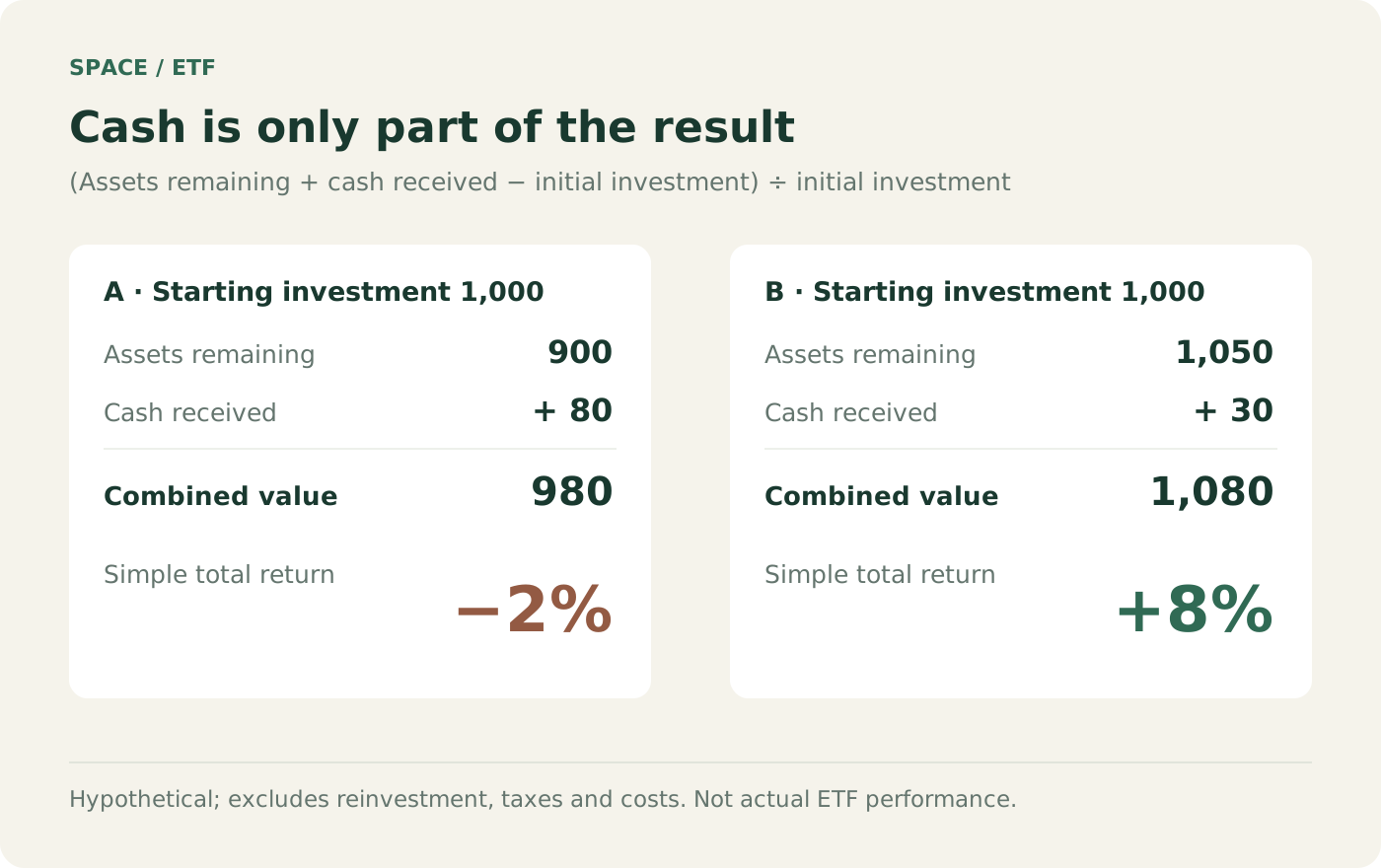
The diagram is hypothetical, not QQQI performance. Whether payments were set aside or reinvested, use consistent treatment when making comparisons. A price-only chart can miss cash already distributed. A distribution-only chart can miss a decline in the assets that remain.
Consider two people holding the same number of shares: one spends every payment and the other reinvests it. Their later account balances will differ even if they experienced the same fund returns. This is an effect of their choices, not evidence that the product behaved differently for each investor. A fair comparison separates those layers.
A payment's tax label and its economic result
Monthly Section 19(a) notices provide estimates of distribution composition. They may include return of capital, or ROC. Final year-end classifications can differ. A label alone does not settle whether the investment generated economic profit or eroded capital; the complete return and asset-value record are also necessary.
US tax features of index options do not guarantee identical benefits for investors elsewhere. A Korean resident should consider the rules applicable to their own account and circumstances. Converting dollar payments into spending money in won adds exchange-rate effects and conversion costs. These conditions stand between a marketing description and the amount ultimately available to spend.
Do not stretch a short history
QQQI began in 2024. Its live record cannot yet demonstrate behavior across many long recessions and recoveries. Attaching an assumed distribution rate to ten years of Nasdaq history would create a model, not QQQI's past performance. It would not establish the future either.
For a comparison with JEPQ and GPIQ, begin when all three funds existed. Align dates, reinvestment, currency and expense treatment. Then examine total return and drawdowns together. Choosing one month with a larger payout mostly compares a distribution decision rather than the full investment experience.
The useful questions are straightforward: which transactions supported the cash, what appreciation was exchanged for it, and what happened to the capital left behind? Once those questions become habitual, a striking percentage becomes the beginning of an investigation rather than the end of one.
Sources and dates
Reviewed on October 22, 2026. Observations belong to the dates stated in the text. Distributions and expenses can change.