A dividend arriving in an account feels different from a price moving on a screen. A business has paid out part of its resources, and some of that cash now belongs to you. It is an understandable reason to become interested in dividend investing. It is not, however, a promise that next year's payment will be larger.
SCHD begins with a selection problem: which dividend-paying companies should a fund own? Its full name, Schwab U.S. Dividend Equity ETF, also contains an important reminder. This is equity investing. Receiving cash along the way does not remove the possibility of a substantial fall in capital.
Looking for the capacity to keep paying
SCHD follows the Dow Jones U.S. Dividend 100 Index. The issuer's product information lists a total expense ratio of 0.06% a year and quarterly distributions. It is not a monthly income fund. Someone planning monthly spending needs to account for that difference before comparing headline yields.
The selection framework considers dividend history and financial characteristics. A long record is useful evidence, but a company's profitability and its ability to generate cash relative to debt also matter. Screening seeks a more durable set of dividend payers. It cannot eliminate dividend cuts, and periodic reconstitution means today's portfolio is not permanent.
| Item | What it means for the reader |
|---|---|
| Main strategy | An index-based dividend equity portfolio |
| Listed annual expenses | 0.06%, excluding your trading and currency costs |
| Distribution schedule | Quarterly; amounts are not guaranteed |
| Option selling | Not the central investment strategy |
| Useful performance measure | Total return with distributions treated consistently |
Two funds can both own large American companies and still behave differently. Dividend selection changes sector weights and exposure to fast-growing businesses. A market led by companies with modest dividends can leave a dividend portfolio behind. That does not automatically make the strategy broken. It makes the choice of benchmark and the reason for owning the fund important.
A lower share price is not automatically a bargain
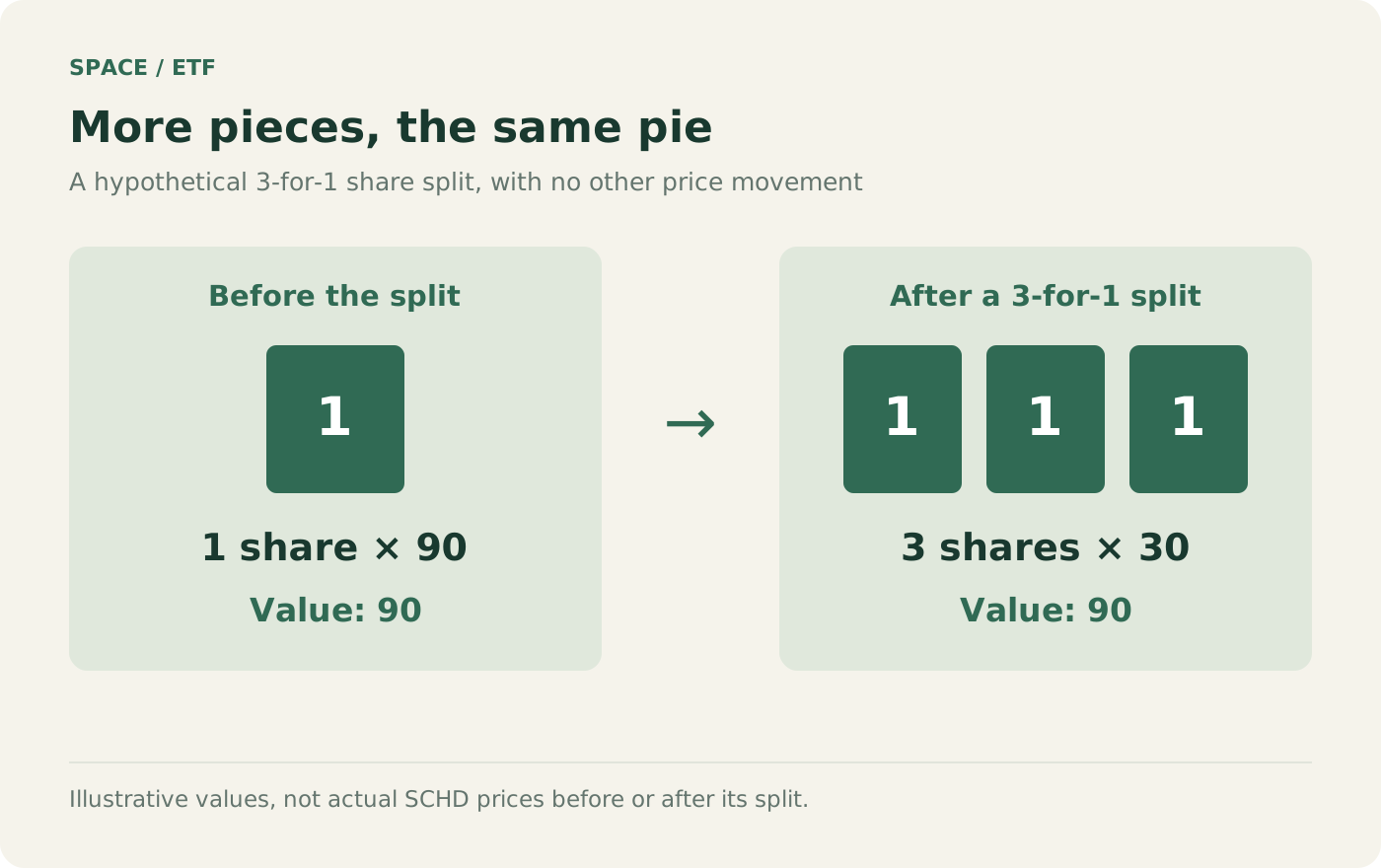
SCHD began trading on a three-for-one split-adjusted basis on October 11, 2024. This matters when reading older articles. A share becomes three shares, while the value per share adjusts proportionately. The split itself does not create additional wealth.
 View full-size figure (new tab) ↗
The diagram uses invented prices to explain arithmetic, not SCHD's historical execution price. Per-share distributions must also be put on a consistent split-adjusted basis. Comparing an old payment per share with a new one without adjustment can create a false impression of a large dividend cut. Likewise, an old quotation in the eighties should not simply be relabeled as today's price.
Reinvestment changes what happens next
Suppose an investment worth $1,000 makes a $10 distribution. Holding everything else constant, the fund's net asset value adjusts for the cash that leaves. It is not correct to describe this as an unchanged $1,000 investment plus $10 of newly created wealth. You need to count the remaining investment and the cash together.
Reinvestment uses that cash to buy more shares. Those additional shares may participate in future business growth and distributions. But declining prices or lower payments change the outcome. A spreadsheet that repeats one dividend-growth assumption for fifteen years describes that assumption, not a contractual feature of SCHD.
Spending the distribution creates a different path. Money withdrawn for groceries no longer participates in the fund's future returns. Consequently, a reinvested performance chart cannot be used unchanged as a forecast of the account balance of someone who spends every distribution.
A practical way to review the holding
Start with the latest holdings and sector weights. Compare them with investments you already own. Buying a second ticker is not necessarily adding a second source of risk. Then review annual distributions on a split-adjusted basis and compare total returns over the same dates, using the same treatment of distributions.
If your spending currency is not the dollar, add another line to the calculation. The same dollar payment can buy a different amount of local currency next quarter. Taxes, brokerage charges and conversion costs also affect what reaches your spending account. A universal tax assumption is less useful than checking the rules that actually apply to your account and residence.
Understanding SCHD does not mean predicting exactly how large its future dividend will become. It means being able to describe its selection rules, payment schedule and remaining equity risk. Those three sentences make a more dependable starting point than a smooth projection of ever-rising income.
Sources and dates
Reviewed on October 22, 2026. Observations belong to the dates stated in the text. Distributions and expenses can change.