A high dividend yield can tell two very different stories. A healthy business may be returning abundant cash to its owners. Or a troubled business may have suffered a falling share price, making yesterday's dividend look unusually large relative to today's price. The number alone does not tell you which story you are buying.
QDIV adds a second question: what does the company's financial quality look like? “Quality” is not a guarantee, but in this fund it points to a defined screening process rather than simply an attractive adjective.
Passing two screens
The Global X S&P 500 Quality Dividend ETF tracks the S&P 500 Quality High Dividend Index. The issuer describes eligibility through two rankings within the S&P 500: companies must rank among the top 200 for both quality and dividend yield. The intersection matters. This does not mean the ETF automatically owns 200 stocks.
Quality measures include return on equity, accruals and financial leverage. In everyday terms, the process examines profitability, the character of reported earnings and the burden of borrowing. A numerical screen can apply rules consistently, but financial statements cannot reveal every future change in a business.
| Official observation | Value and reporting date |
|---|---|
| Total expense ratio | 0.20% annually |
| Distribution schedule | Monthly |
| Number of holdings | 50, October 9, 2026 |
| Net assets | $28.79 million, same date |
| Trailing 12-month distribution percentage | 2.87%, same date |
| 30-day SEC yield | 2.68%, same date |
These are dated observations, not live quotations. Our October 22 review date does not turn the October 9 portfolio into October 22 data. A trade should begin with the latest available holdings and market prices.
Monthly is a schedule, not a return
Receiving cash twelve times a year rather than four changes the payment calendar. It does not create more annual cash if the annual total is unchanged. QDIV's schedule may be convenient, but it should not be confused with the income engine of an option-writing fund such as JEPI or QQQI.
QDIV is principally a dividend-stock selection strategy. A fund that sells equity upside to collect option premiums makes a different trade-off. Comparing the funds solely because they all pay monthly hides that distinction.
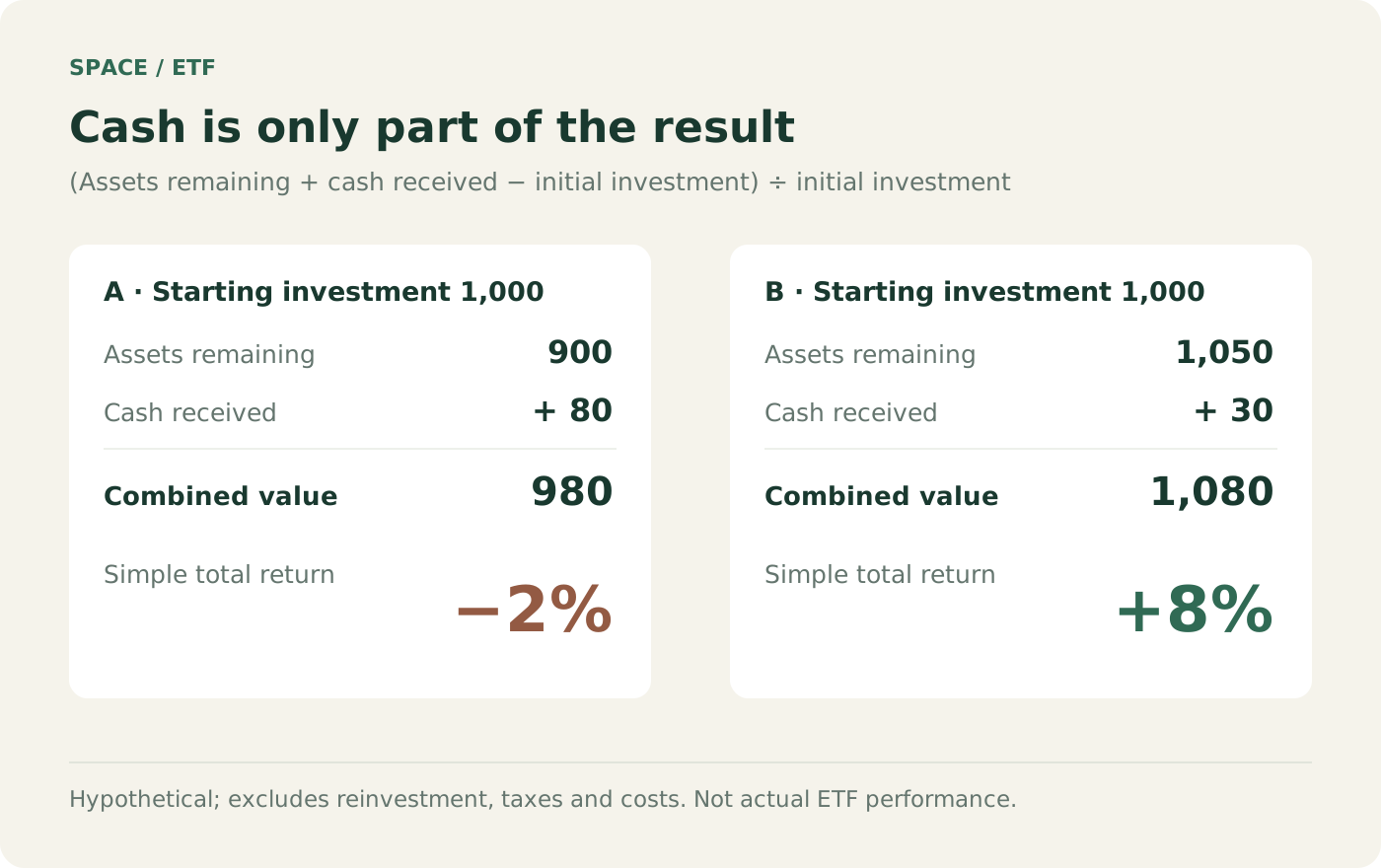 View full-size figure (new tab) ↗
The illustration shows why the account with the largest cash payments is not necessarily the account that earned the most. A dividend ETF also adjusts for distributions. Price changes and cash received belong in the same calculation. A trailing distribution percentage describes past payments relative to a stated denominator; it is not a promise about the coming year.
Trading costs deserve a separate line
Fund size alone is not a verdict on investment quality. However, the spread between buying and selling prices can matter, especially when a reader places a large order relative to available liquidity. A low annual expense ratio does not eliminate the cost of entering and leaving a position.
Imagine an offer price of 100 and a bid of 99.7. With all else unchanged, buying and immediately selling introduces a 0.3 difference before brokerage charges. This is a made-up example, not a quotation for QDIV. It explains why checking the order book and understanding a limit order can be as practical as comparing management expenses.
The point is not to turn a long-term reader into a short-term trader. It is to separate an ongoing fund cost from a transaction cost. They reach the investor through different mechanisms and should not be treated as interchangeable numbers.
Comparing it with SCHD
Both products examine dividends, but their indexes, selection rules, fees and payment calendars differ. Put their sector weights and overlapping holdings next to each other. Compare total returns over identical dates and use the same reinvestment assumption. Then ask whether monthly payments solve a real budgeting need or simply look more appealing on a calendar.
A company that looks financially strong today can change. The useful habit is therefore not to trust the word “quality” indefinitely, but to understand what measures produce the label. After noticing an attractive yield, ask why it is high. That question remains useful long after today's fund table has been updated.
Sources and dates
Reviewed on October 22, 2026. Observations belong to the dates stated in the text. Distributions and expenses can change.