After reading about American dividend ETFs, a Korean investor may ask a practical question: can I use won to buy familiar domestic businesses and receive distributions in won? PLUS High Dividend is one answer to that question. Calling it a “Korean SCHD,” however, skips too much of the explanation.
Dividend funds can use different selection rules and invest in different economies. Translating a nickname does not translate the portfolio. The useful starting point is the actual rule used to select Korean companies.
Thirty companies, selected with an estimate
PLUS High Dividend, ticker 161510, is managed by Hanwha Asset Management and follows the FnGuide High Dividend Index. The selection begins with the top 200 companies by free-float market capitalization and identifies 30 with high expected dividend yields. “Expected” matters: an estimate of a future payment is not the payment itself.
A larger dividend can come from steadily rising earnings, but it can also reflect a one-off asset sale or an unusual distribution. Looking at the source of the cash gives you a better question for the next year than simply extrapolating the largest number in the table.
| Item | Official information reviewed |
|---|---|
| Korean ticker | 161510 |
| Listed annual fund fee | 0.23%; other expenses and trading costs are additional |
| Listing date | August 29, 2012 |
| Distribution record schedule | Last business day of each month, with stated accounting-period provisions |
| Regular constituent review | Twice yearly, June and December |
| NAV observation | KRW 23,104.66 on October 21, 2026 |
NAV is the fund's net assets per unit, not necessarily the price at which your order executes. The observation is neither a live quotation nor an estimate of a fair buying price.
What monthly payments change
A monthly schedule changes the rhythm of cash receipts. That can help a household budget. It does not automatically increase corporate profits or the fund's total return. When comparing older annual payments with newer monthly ones, first put both on the same annual basis.
Check whether a special distribution is included and whether the payment policy changed. Multiplying the most recent payment by twelve is an annualization assumption, not a guarantee. A sensible income budget needs room for a smaller payment as well as a larger one.
 View full-size figure (new tab) ↗
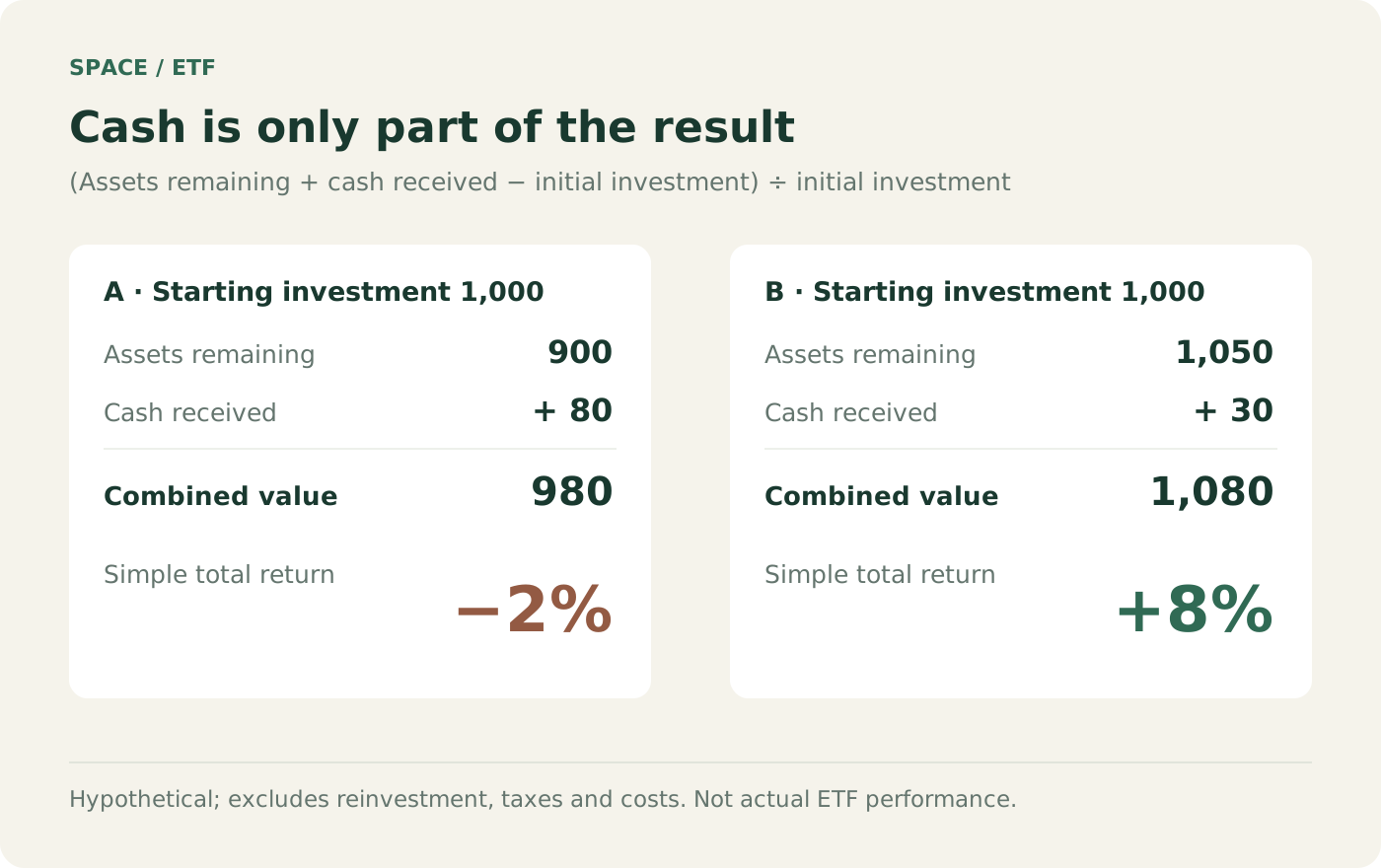
Buying immediately before a distribution does not lock in a free gain. Assets leave the fund when it distributes cash, while market prices also respond to other developments. Counting the cash without counting the value remaining in the investment produces an incomplete result.
Familiar names can share the same risk
A domestic high-dividend screen can produce meaningful exposure to particular industries. Financial companies, for example, can respond together to credit conditions, capital requirements and the economic cycle. Different company names do not necessarily represent independent sources of risk.
The issuer's October 21, 2026 holdings showed DB Insurance, Woori Financial Group and Industrial Bank of Korea among the leading positions. That is a dated observation, not a permanent list. Older holdings tables should not be carried forward unchanged. The lasting skill is to read sector concentration rather than memorize a top-ten ranking.
Someone who already owns Korean financial stocks should calculate exposure across the whole portfolio. A new account or an additional ETF does not by itself create diversification. Trading conveniently in won also leaves Korean equity-market risk intact.
Spending and accumulating are different jobs
An investor reinvesting distributions is increasing the number of units that can participate in future results. Someone spending the payments needs to know whether a smaller distribution would disrupt the household budget. Both can own the same fund, but their review questions should differ.
The listed 0.23% fee is not an all-inclusive personal cost. Other fund expenses, commissions and bid–ask spreads deserve attention. Tax treatment also depends on the account and investor. When comparing domestic and overseas products, a consistent after-cost calculation is more useful than assuming that one tax rate applies everywhere.
PLUS High Dividend is a way to participate in distributions from selected Korean businesses. The reason to own it should begin with that market and those selection rules. A familiar overseas nickname is not enough to explain what you will do when dividends or share prices disappoint.
Sources and dates
Reviewed on October 22, 2026. Observations belong to the dates stated in the text. Distributions and expenses can change.