A payment arriving once a month can look orderly. The stocks and options producing it move on a much less orderly schedule. GPIQ makes more sense when these two clocks are kept separate: a distribution calendar tells us when cash may arrive, not how stable the underlying investment will be.
The current name is Goldman Sachs Nasdaq-100 Premium Income ETF. Older material may include “Core,” so use the ticker and current documents to identify the fund. The Nasdaq-100 is an index, not an ETF, and represents large nonfinancial companies listed on Nasdaq. It is not a collection of one hundred pure technology businesses.
Choosing assets and choosing coverage
Changing the equity foundation changes the outcome even when an option strategy sounds similar. Compared with GPIX's broad US large-cap starting point, GPIQ is more closely associated with the Nasdaq-100's composition and concentration. Splitting an investment between the two does not automatically split its economic risks into independent halves. Large companies can overlap.
| Item | How to read GPIQ |
|---|---|
| Launch | October 24, 2023 |
| Equity exposure | Large US growth-oriented companies around the Nasdaq-100 |
| Income approach | An adjustable option-writing overlay |
| Payments | Monthly, without a guaranteed amount |
| Gross annual expenses | 0.35% |
| Net annual expenses | 0.29%, reflecting a waiver through at least April 30, 2027 |
The issuer's fee waiver has contractual conditions. Recording both figures makes a later change easier to interpret. Lower expenses help, but a few basis points cannot erase differences in stocks or derivative structures. One basis point equals 0.01 percentage point. The fund's actual return still depends far more on what its investments do than on this small arithmetic exercise.
What comes with a larger premium?
An option's price reflects several inputs, including its underlying asset, strike, time to expiration and expected volatility. The possibility of larger price moves can increase what buyers are willing to pay. That is not simply better news for the seller: the underlying stocks can also suffer substantial losses.
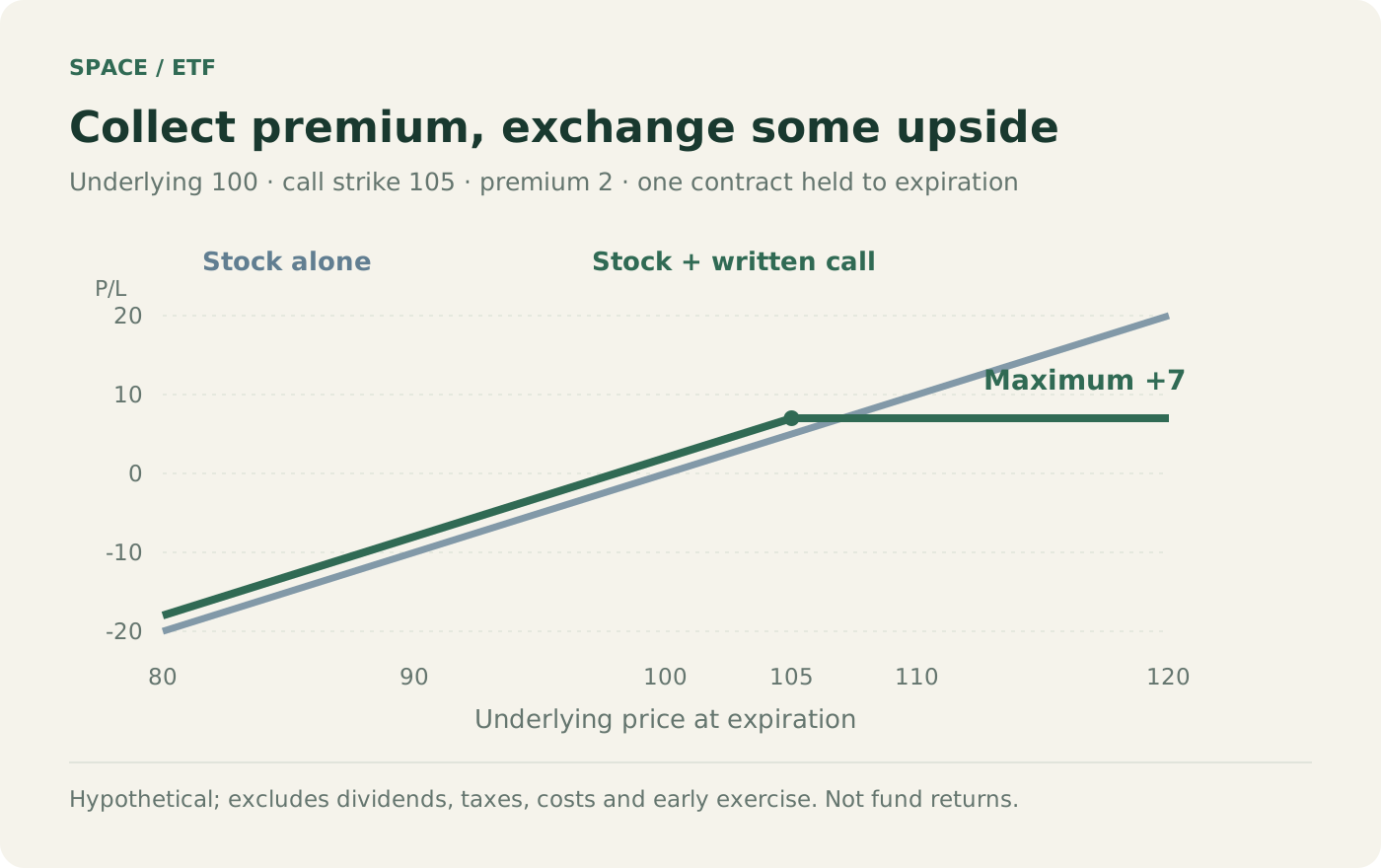
Adjusting option coverage does not secure an identical monthly distribution. Collecting more premium and preserving more room for appreciation involve a trade-off. Managers can change coverage as conditions evolve, but the market path afterward can differ from the one they anticipated.
 View full-size figure (new tab) ↗
This is a conceptual illustration, not GPIQ performance. A real fund rolls and adjusts multiple contracts. A sharp decline followed by a rapid rebound can be particularly revealing: the portfolio may participate in the fall while an overlay limits some of the recovery. Receiving cash each month does not establish that the journey was comfortable.
Before translating a rate into a household budget
Multiplying a recent payment by twelve and dividing by a share price produces an annualized figure. It assumes repetition. It is different from adding the payments actually received over the previous year, and both measures differ from total return, which also considers the value remaining invested.
Consider what would happen if distributions fell. Then consider whether a simultaneous decline in the fund would force sales to cover spending. Those two developments can reinforce each other in a household budget. Monthly payments do not transfer responsibility for spending reserves from the investor to the fund.
For a Korean investor, also separate the dollar result from the won result. Exchange-rate changes and conversion charges affect money eventually spent in won. Rising dollar distributions do not guarantee rising won receipts. Equally, an exchange-rate gain should not be attributed entirely to the manager's stock selection or option decisions.
An investor who reinvests every payment faces another useful question: is the distribution schedule itself helping meet the goal? Reinvestment can support compounding, but the cash was not created outside the fund's economics. An ex-distribution adjustment and personal tax treatment can matter even when the deposit is immediately invested again.
Put the mechanism above the ranking
When comparing GPIQ, JEPQ and QQQI, begin with the stocks and contracts behind the cash. Direct index options and equity-linked notes are not interchangeable structures. Then align the comparison dates and examine reinvested total return, drawdowns and expenses together.
GPIQ's live record begins in 2023. A precise-looking table showing wealth and distributions ten years from now is a calculation built on assumptions, not an observed outcome. Distinguishing those two categories lets an investor appreciate regular income while still acknowledging the risks of the growth stocks underneath it.
Sources and dates
Reviewed on October 22, 2026. Observations belong to the dates stated in the text. Distributions and expenses can change.