The first interest payment Jiyun received could buy a few coffees. She looked at the number on her phone for a while. For something often described as money working for you, the result was remarkably quiet.
Small amounts earn small amounts. There is no mystery there. What changes the arithmetic is allowing returns to become part of the amount on which future returns are calculated. Before we explore that, though, we need to examine two details often hidden behind a prominent percentage: the period and the balance to which it applies.
Five percent of what, and for how long?
If you lend 1 million won for a year and receive 50,000 won in interest, the annual interest rate is 5%. Interest is payment for the use of money over time. It is income to the lender and a cost to the borrower.
The percentage alone does not make two offers comparable. Is it annual or monthly? Before or after tax? Conditional on other purchases or account activity? Does all the money stay invested for the same length of time?
Consider a savings plan into which you pay 100,000 won each month for a year. The first payment remains in the account much longer than the last. Multiplying the eventual 1.2 million won of contributions by the advertised annual rate will generally overstate the interest. Exact proceeds depend on payment dates and the contract’s calculation method.
Loans deserve the same attention. Even with the same annual rate, different repayment schedules and fees produce different total costs. A smaller monthly payment does not necessarily mean a cheaper loan. Extending the term can reduce each payment while increasing total interest.
When the interest stays
Let us remove the complications for a moment. Imagine 1 million won earning 5% a year, with no tax, no fees, no additional deposits, and the same rate every year.
After one year, there is 1.05 million won. If the 50,000 won of interest is taken out and not reinvested, the original 1 million continues to earn 50,000 each year. This is simple interest.
If the interest remains and earns the same rate, the second year starts with 1.05 million. Five percent of that is 52,500 won. The balance becomes 1,102,500. This is compound interest: earlier interest participates in later calculations.
| Time elapsed | Principal plus simple interest | Balance with annual compounding |
|---|---|---|
| 1 year | KRW 1,050,000 | About KRW 1,050,000 |
| 5 years | KRW 1,250,000 | About KRW 1,276,000 |
| 10 years | KRW 1,500,000 | About KRW 1,629,000 |
| 20 years | KRW 2,000,000 | About KRW 2,653,000 |
| 30 years | KRW 2,500,000 | About KRW 4,322,000 |
Illustration: 5% every year, annual compounding, no additional contributions, taxes, or costs. The simple-interest column includes accumulated interest without reinvestment. This is not a product forecast.
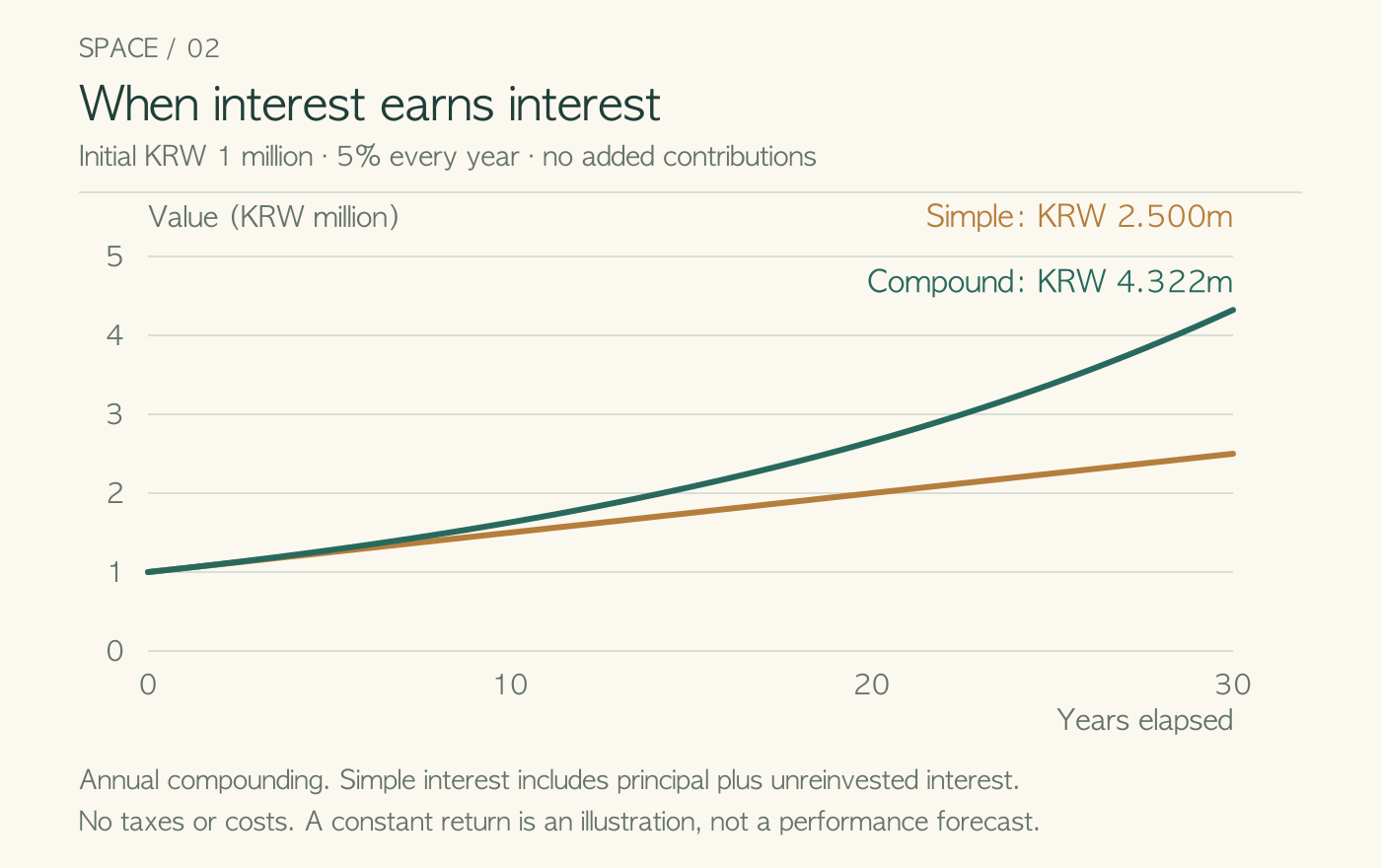
Figure: an original illustration based on the assumptions and calculations in the text.
The gap is small at first. After five years, it is about 26,000 won. After thirty, it is about 1.82 million. Later interest is calculated on a much larger balance.
A compound-interest calculation needs several inputs: starting principal, rate, time, additional contributions, and compounding frequency. The SEC’s educational calculator asks for these separately. Investor.gov compound interest calculator
For this example, the rule is simply to multiply the balance by 1.05 for each year. The familiar formula, principal multiplied by (1 + annual return) raised to the number of years, is a compact way of repeating that operation.
The smooth curve is an assumption
Compound-growth charts usually rise smoothly. Look at enough of them and real investing can start to feel equally orderly. Yet the smoothness comes from assuming a constant positive return. It is not a promise made by the market.
Suppose 1 million won rises by 20% to 1.2 million, then falls by 20% the following year. The ending balance is 960,000 won. The arithmetic average of the two yearly returns is zero, but the money has fallen by 4%.
The percentage increase applied to 1 million. The percentage decrease applied to 1.2 million.
KRW 1,000,000 ── +20% ──▶ KRW 1,200,000
                                  │
                                −20%
                                  ↓
                             KRW 960,000
Equal percentage gains and losses act on different starting balances.
Understanding compounding in an investment means recognizing that each period changes the next period’s starting point. It does not mean every asset eventually recovers. A business can fail. An investment can suffer a permanent loss. Reinvesting returns also matters: withdrawals leave less money participating in future growth.
Even a deposit has a time boundary. A rate fixed for one year may not be available when the deposit matures. Extending that rate across thirty years turns a contractual fact about one year into an assumption about the other twenty-nine.
The contribution matters too
Beginners can spend days choosing between a 4% return and a 5% return. Rates and costs deserve attention, but scale matters. On 1 million won, a one-percentage-point difference amounts to 10,000 won over one year before tax, using simple arithmetic.
Finding a sustainable way to save an additional 50,000 won each month adds 600,000 won of principal over the year. Early in the process, consistent contributions can affect the outcome more than a small improvement in returns.
This is not an argument for cutting every pleasure. It is a way to identify which variables you can influence. You may be able to change your savings schedule or remove an unused expense. You cannot instruct the stock market to deliver a particular return next year.
Costs become more consequential over long periods. A fee removes money today and also removes the future growth that money might have earned. Distinguish the return advertised for a product from the return you actually retain. Inflation introduces another difference: a larger balance may not buy proportionately more. We will examine that in the next lesson.
Time also belongs to the lender
While checking her savings calculations, Jiyun opens her loan statement. If she holds a loan charging 8% and a deposit paying 4%, both clocks are running.
Keeping a 1-million-won loan balance outstanding for a full year would cost 80,000 won in a simplified calculation. Depositing the same amount at 4% earns 40,000 before tax. The comparison helps explain why reducing debt can have substantial value.
A real decision also depends on repayment timing, early-repayment charges, taxes, and cash needed for ordinary expenses. Paying down a loan while leaving too little to live on may lead to fresh borrowing. The arithmetic is useful; it does not settle every household’s priorities.
Nor does every loan automatically compound. Interest treatment depends on the contract. Overdue interest or terms that add interest to principal can change the cost. When a clause is unclear, its exact wording matters more than a general slogan about debt.
Before opening the calculator
Choose one savings product and write down the amount, annual rate, deposit date, and withdrawal date. Check whether you qualify for that rate. Then look at the proceeds after taxes and costs.
For an investment plan, try more than one outcome. Place a low-return case and a loss case beside a middle case. Ask whether the goal date still works. Raising the assumed return until the answer becomes pleasant does not repair the plan; it merely changes the input.
Jiyun still thinks her first interest payment looks small. But she now asks how long it can remain, and what might force her to withdraw it. Time can only do its part if her finances leave room to wait.