A café owner is considering a second location. She would need to borrow 100 million won for the deposit and equipment. At 3% annual interest, the simplified cost is 3 million won a year if the full principal remains outstanding. At 6%, it is 6 million.
The premises and menu have not changed. The amount the new shop must earn has.
This is one way to enter an interest-rate story. A number announced by a central bank eventually touches shop leases, household loans, and savings decisions. It does not touch everyone in the same way.
There is more than one interest rate
A policy rate is a key rate a central bank uses in conducting monetary policy. The rates you encounter at a bank are connected to it, but they are not identical.
Funding costs, credit quality, loan terms, collateral, and competition all influence the rate offered to a particular borrower. A quarter-percentage-point policy cut does not mean every loan becomes a quarter point cheaper immediately.
A fixed-rate contract generally retains its agreed rate for the fixed period. A variable-rate contract has its own reference rate and adjustment schedule. Knowing your contract can matter more to next month’s budget than knowing the latest headline.
Higher rates can discourage borrowing and encourage saving, tending to restrain demand. The effects take time and vary across households and firms. The Bank of England’s educational material describes the connection between policy rates, bank lending and savings rates, and economic activity. Bank of England interest-rate questions
Policy-rate change
        ↓
Market rates and bank terms
        ↓
Spending and investment decisions
        ↓
Demand and inflation over time
A simplified transmission path. Timing and strength vary, and other channels also operate.
The café owner may postpone expansion. A household with substantial deposits may receive more interest. Both experiences can occur during the same rate cycle. Neither alone tells the whole economic story.
A bond is a promise from a borrower
Buying a bond means lending to an issuer, such as a government or company. Its terms describe the payments due and when principal is to be repaid.
The promised principal is often called face value or par value. Interest payments are called coupons. The repayment date is maturity.
Structures vary. Some bonds make no interim interest payments; others have floating rates. For this lesson, we will use a fixed-payment example. Actual bonds also carry credit risk: the issuer may fail to meet its obligations. Investor.gov bond guide
A holder may want to sell before maturity. Another investor can buy the remaining promised payments, but need not pay the original purchase price. The promises may be unchanged while the price investors are willing to pay for them moves.
What is 1.03 million won next year worth today?
Imagine a bond that pays exactly 1.03 million won one year from today, combining principal and interest. It makes no payments before then. Assume the issuer pays in full.
At a price of 1 million won, it offers a 3% return. Now suppose comparable bonds with the same maturity and risk offer 5%. An investor could pay 1 million for a future payment of 1.05 million. The old bond’s 1.03 million looks less attractive at the same price.
But reduce its price to about 980,952 won, and the calculation changes. Paying that amount to receive 1.03 million after a year produces a return of approximately 5%.
Price today = payment in one year ÷ (1 + required annual yield)
KRW 1,030,000 ÷ 1.05 ≈ KRW 980,952
We can repeat the calculation at different required yields.
| Required yield for the same risk and maturity | Payment in one year | Calculated price today |
|---|---|---|
| 1% | KRW 1,030,000 | About KRW 1,019,802 |
| 3% | KRW 1,030,000 | KRW 1,000,000 |
| 5% | KRW 1,030,000 | About KRW 980,952 |
An invented single-payment bond with exactly one year remaining in every case. No default, tax, fees, or interim payments.
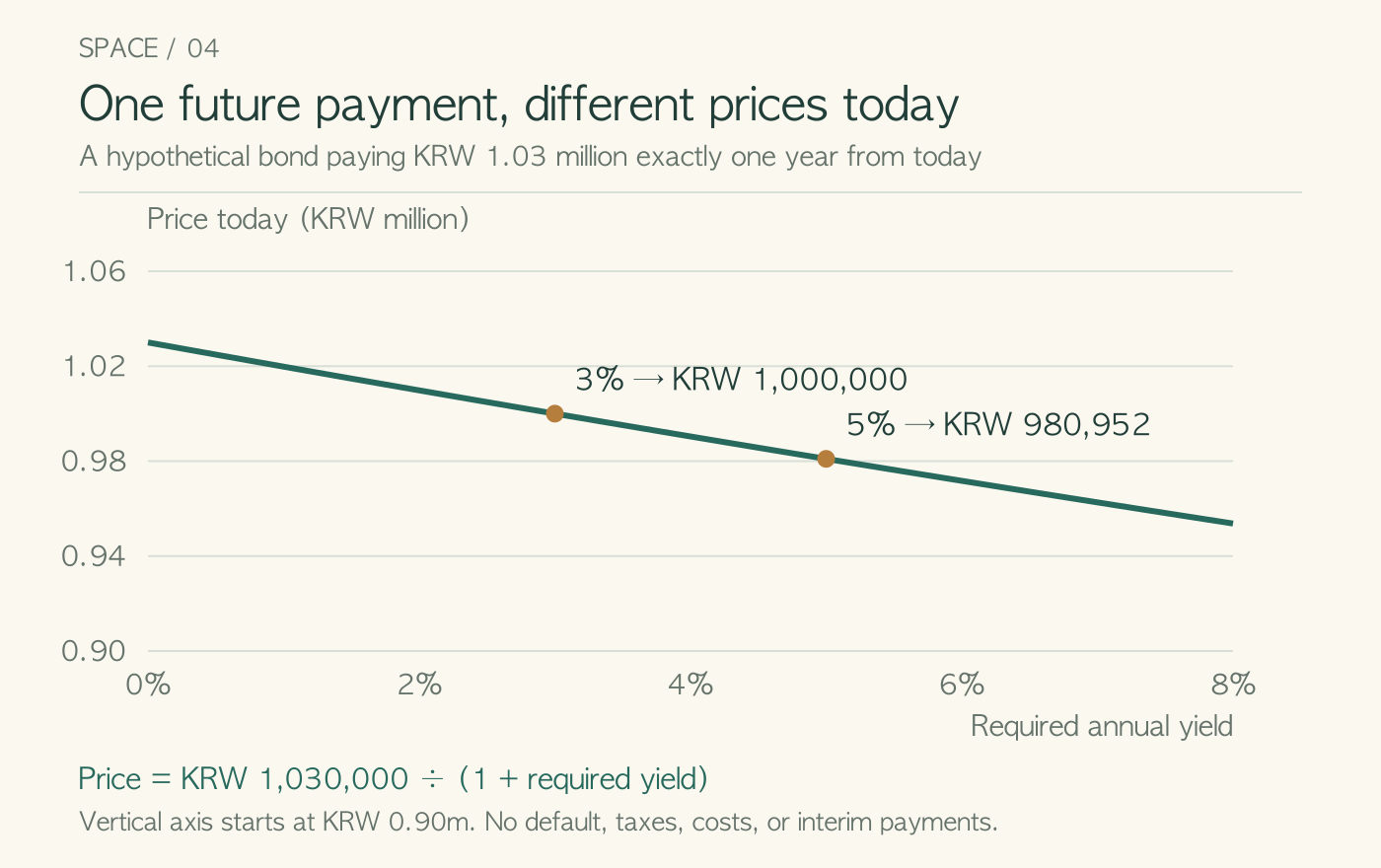
Figure: an original illustration based on the assumptions and calculations in the text.
For a fixed future payment, a higher required yield implies a lower price today. This is the foundation of the familiar statement that bond prices fall when yields rise.
It does not imply that every bond yield follows the central bank’s policy rate in exactly the same direction or by the same amount. Different maturities, expectations, and credit conditions can produce different movements.
A coupon is not your return
The coupon terms determine promised interest payments. Your return also depends on the purchase price.
If you buy below face value, repayment at face value contributes a price gain. If you buy above face value, the reverse applies. Looking only at the coupon overlooks part of the investment.
Yield to maturity is a calculation connecting today’s price to scheduled future payments. It assumes those payments are made. For a bond with interim coupons, the rate at which those coupons can be reinvested also affects the compound return actually achieved over the holding period.
A displayed yield therefore needs interpretation. It should not automatically be read as a guaranteed rate on a bank deposit.
Longer-maturity bonds contain payments further in the future. Other things being similar, their prices are often more sensitive to changes in required yields. Duration is a measure used to examine interest-rate sensitivity. For a first reading, the practical question is enough: how much might this price move if market yields change?
What does holding to maturity solve?
If you hold an individual bond to maturity and the issuer fulfils its obligations, you receive the promised payments despite interim market-price changes. That can matter greatly to an investor matching a future expense.
But you may need the money earlier. Selling then exposes you to the market price available at that time. Inflation may also reduce the purchasing power of the money eventually returned.
Credit risk remains. A high yield can reflect concern about the issuer’s ability to pay, rather than a particularly generous opportunity. Calling something a bond does not make the borrower reliable.
An ordinary bond fund or bond ETF usually maintains a portfolio by buying and replacing holdings. It generally does not promise each investor a particular principal amount on a personal maturity date. Some products have target-maturity structures, but their terms and risks still need examination.
This distinction matters when someone says, “I can just wait until maturity.” That statement means one thing for a specific bond and something else for a fund that keeps owning a changing collection of bonds.
There is a further practical question: in what currency will repayment arrive? A reliable payment in a foreign currency can still change in value relative to the currency in which you pay your bills. Credit quality, interest-rate exposure, and currency exposure are separate pieces of the decision.
You do not need to forecast the next central bank meeting to use this lesson. Start by finding whether your own loan is fixed or variable, and when its rate next resets. For a bond investment, note the maturity structure, credit risk, possible price movement, and whether you might need to sell early.
The café owner has not signed the new lease. She has translated the difference between 3% and 6% into a cost the shop must cover, then tested a month with disappointing sales. Understanding interest rates makes that calculation possible.